Computational Media & Domestic Environments

Computational Media & Domestic Environments

 A project exhibited in The HYBRID CITY II: Subtle rEvolutions 
(part of Stavros Didakis‘ PhD research in i-DAT, Plymouth University, fully funded by Onassis Foundation)
 
In this project, computational media and sensor technologies are used to measure, analyze, and control aspects of the domestic environment. Reading the measurable world from macro to micro, a large number of possibilities may create unexpected, flexible, and personalized spaces that enhance living qualities of inhabitants, providing added layers of information, affectivity, and aesthetics with the use of calm technologies and ubiquitous computing. Fundamental consideration in this case is to construct sensate spaces that may establish the domestication of computational media with prior interest to elevate aspects of the inhabitants’ well-being, such as mood, emotion, experience, and perception.
 
Environmental conditions, spatial information, circulation, virtual and physical navigation, social media, or biosensors can collectively define quantitative or qualitative information that is used to properly adjust and personalize each environment and closely match taste and preferences. With the development of middleware applications it becomes even more feasible to approach this goal, providing necessary tools to create links between incoming data and outgoing processes, establish important automations, or suggest new creative and imaginative interactions. Therefore, it is possible to instantly create connections between an isolated sensor reading and projected visualizations, or use a number of similar sensors to control the overall interior lighting. Extracting specific keywords from social media messages or using sentiment analysis methods to define mood and emotion, it becomes possible to directly configure properties of a personal space as a multi-layered canvas. The final result of the configured space can provide a single pixel in the larger screen of the Hybrid City so as the overall well-being may be mirrored, provoke self-consciousness, and define a cartography of lifestyles and living conditions.

androidScreen.png

Middleware application to link input information to media devices (light, audio, music, visuals, etc)

lightingspace

Realtime simulation in Unity (hardware under development)

mapAthens

Upload final results in Google Maps to provide instant visualization of multiple sources / homes

Devonport Open Event

Devonport Open Event


Devonport Guildhall, Ker Street, Devonport
http://goo.gl/hl10k
ALL WELCOME
Friday 3rd February 2012
2pm – 4pm


An one-off event showcasing a series of exploratory projects which
reveal invisible histories, memories and traces in and around Devonport. These projects embed and reveal information about the past, present and future. They explore the use of interactive mobile media, smart objects and projection to suggest new ways of experiencing, interacting and engaging with our built environment.
Background.
Fourty students from the Schools of Architecture and the Digital Art and Technology have worked to create interactive projects that address the following topic:
How can we bridge the gap between the digital and the physical, the material and the immaterial transforming the way we interact with the space around us?
Organisers:
Unit Inbetween, School of Architecture and i-Dat, University of Plymouth
with the kind support of RiO (Real Ideas Organisation)
Further information:
Katharine.willis@plymouth.ac.uk / Gianni.corino@plymouth.ac.uk
PDF flyer

i-DAT/Submerge Interactive Architecture Residency.

i-DAT/Submerge Interactive Architecture Residency.

i-500news.jpg
Dr Paul Thomas, Artistic Director of BEAP.(Biennale of Electronic Arts Perth 2007) will be the i-DAT Interactive Architecture Resident artist during the month of July. Thomas will be further developing Arch-OS through the i-500 Project extension. With funding provided by Curtin University the residency will focus on the articulation of the dynamic data generated by the public art instillation to be incorporated into the fabric of the Curtin University of Technology Minerals and Chemistry Research and Education Precinct buildings. http://www.i-500.org

Sloth-bot

Sloth-bot

At 6pm on the 22 July, during the Consciousness Reframed, 8th International Research Conference (21 – 23 July 2006) the ‘Sloth-bot’ will be launched as an extension of the Arch-OS project. Sloth-bots are large autonomous robots that move incredibly slowly (between 5mm and 20mm a minute). Sloth-bots, influenced by their interactions with people, imperceptibly reconfigure the architecture. Sloth-bots build on robotic technology developed by Dr Guido Bugmann, famously incorporated into Donald Rodney’s Psalms which was exhibited in the South London Gallery as a part of Rodney’s last exhibition entitled ‘Nine Night in Eldorado’, in October 1997. http://arch-os.com/projects/slothbot/

Sloth-bot

Sloth-bot

22- /07/2006

At 6pm on the 22 July, during the Consciousness Reframed, 8th International Research Conference (21 – 23 July 2006) the ‘Sloth-bot’ will be launched as an extension of the Arch-OS project. Sloth-bots are large autonomous robots that move incredibly slowly (between 5mm and 20mm a minute). Sloth-bots, influenced by their interactions with people, imperceptibly reconfigure the architecture. Sloth-bots build on robotic technology developed by Dr Guido Bugmann, famously incorporated into Donald Rodney’s ‘Psalms’ which was exhibited in the South London Gallery as a part of Rodney’s last exhibition entitled ‘Nine Night in Eldorado’, in October 1997.

http://www.arch-os.com/

Arch-OS.

Arch-OS.

07/2005:


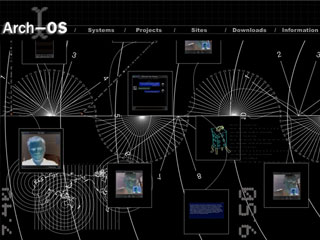
Arch-OS constructs a ‘virtual’ architecture from the dynamic activities that take place within the Portland Square Development. Arch-OS uses a range of embedded technologies to capture audio-visual and raw digital data from the building through: the Building Management System; its computer and communications networks; the flow of people within it; changing noise levels; weather, light and temperature changes. This vibrant data is then manipulated (using computer simulation, visualisation and audio technologies) and replayed through projection systems incorporated into the architecture and broadcast using streaming internet technologies. https://arch-os.com/

Out of Scale

Out of Scale

16/06/2004:

Plymouth Arts Centre.Out of Scale explores architecture’s relationship with image, digital technology, structure and materials, by focusing upon microscopic detail. The show reveals the unusual relationship that architects have with scale; how the digital systems and measuring tools transform models of actuality, from the precision of the scalpel blade used to make a model to the materials used to construct the finished building.

Original HTML website can be found here: https://i-dat.org/wp-content/blogs.dir/oldi-DATprojects/outofscale/index.html

V01D

V01D

22ND JUNE – 22ND JULY 2001.
Through digital processes, forms of architecture are changing. The definitions of buildings, spaces and places have all undergone transformation as digital processes alter the way we design, construct, conceive, present and ultimately experience architecture. As architecture transforms its identity and role, it is an appropriate point to reflect upon the methodologies that have emerged in recent times. To document the less tangible, to critique the crazy and explore the subtle. The V01D show provides the public and architects a chance to see unusual and cutting edge forms of digital architectures. From virtual reality systems, 3D fly-throughs across extraordinary landscapes, and what happens when you let children play with VR technology, the show promises to extend our understandings of buildings as new media emerges and transforms our world. Exhibition runs from 22nd June 22nd July 2001. This exhibition coincides with the Royal Institute of British Architects Architecture.


C O N T E N T S
preface . . . . . . . . . . . . . . . . . . . . . . . . . . . . . . .04
walking with avatars fiona bailey . . . . . . . . . . . . . . . .12
new improved reality digital skin . . . . . . . . . . . . . . . .18
stephen perrella interview oliver lowenstein, encoding by limbomedia .22
we like technology general lighting and power . . . . . . . . . . . .30
occupied territory iain borden . . . . . . . . . . . . . . . . . .40
habitaculus chris speed . . . . . . . . . . . . . . . . . . . . . . .46
psychometric architecture mike phillips . . . . . . . . . . . .52
extending architecture peter anders . . . . . . . . . . . . . . .58
playground geoff cox and drmm . . . . . . . . . . . . . . . . . . . .66
biographies . . . . . . . . . . . . . . . . . . . . . . . . . . .70
acknowledgments . . . . . . . . . . . . . . . . . . . . . . .72
V01D
22nd June – 22nd July 2001
Edited by Chris Speed and George Grinsted
Produced by The Institute of Digital Art and Technology,
Plymouth Arts Centre, limbomedia and Digital Skin.
ISBN 1 84102 087 7
Digitally printed in the UK
Download PDF…