Examining Life at a Nano Level. Dr Paul Thomas.

Examining Life at a Nano Level. Dr Paul Thomas.

Stonehouse Lecture Theatre Portland Square
17.00-18.00 on Friday 3rd December.
Examining Life at a Nano Level.
In this talk Paul Thomas will demonstrate via the nano art project ‘Nanoessence’, ideas on what constitutes the real and the artificial. The ‘Nanoessence’ project aimed to create a visual expression of life at a sub-cellular level, re-examining boundaries and materiality within the human context. A single engineered immortal skin cell was scanned in vitro with an Atomic Force Microscope (AFM) to create a visualisation of the space between, life and death at a nano level. The presentation will explore how nanotechnological research is challenging humanistic ideas concerning life and what constitutes materiality.
Paul Thomas: Dr Paul Thomas, is currently Head of Painting at the College of Fine Art, University of New South Wales. Paul chair numerous international conferences and is the co-chair of the Transdisciplinary Imaging Conference 2010. In 2000 Paul instigated and was the founding Director of the Biennale of Electronic Arts Perth.
Paul has been working in the area of electronic arts since 1981 when he co-founded the group Media-Space. Media-Space was part of the first global link up with artists connected to ARTEX. From 1981-1986 the group was involved in a number of collaborative exhibitions and was instrumental in the establishment a substantial body of research. Paul’s current research project ‘Nanoessence’ explores the space between life and death at a nano level. The project is part of an ongoing collaboration with the Nanochemistry Research Institute, Curtin University of Technology and SymbioticA at the University of Western Australia. The previous project ‘Midas’ was researching at a nano level the transition phase between skin and gold. Paul has recently completed working on an intelligent architecture public art project for the Curtin Mineral and Chemistry Research Precinct. In 2009 he established Collaborative Research in Art Science and Humanity (CRASH) at Curtin http://crash.curtin.edu.au
Paul is a practicing electronic artist whose work has exhibited internationally and can be seen on his website http://www.visiblespace.com
download the invite…

i-500 Project Launch

i-500 Project Launch

i-500 Diagram

i-500 Project Launch

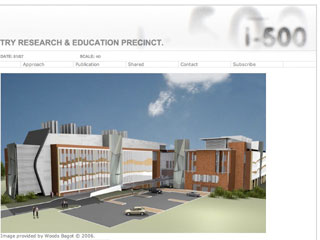
The Premier of Western Australia Colin Barnett has officially opened the new Curtin Resources and Chemistry Precinct and the i-500 Project. The $116 million precinct is the culmination of partnerships between Curtin, BHP Billiton, the Western Australian Government, and the Federal Government.

i-500 Projection

i-500 System

i-500 / Curtin Resources and Chemistry Precinct OpeningChris, Ross and PaulCurtin Resources and Chemistry Precinct

http://www.i-500.org

The i-500 is an artwork that will perform a vital and integral role in the development of scientific research in the fields of nanochemistry, atomic microscopy and computer modelling, applied chemistry, environmental science, biotechnology, and forensic science. Through dynamic visualizations and sonifications the artwork represents quantitative scientific research as an integral part of the architectural environment. The large-scale visual projections, distributed echo nodes and multiple sonic zones that constitute the art work reveal to the occupants a normally invisible dialogue between the researcher, the research community and the environment. The i-500 translates dynamic data from the physical and social interactions within the building into a volatile and evolving interactive art work.

The opening of the Resources and Chemistry Precinct and launch of the i-500 begins an initial engagement between the dynamic art work and the community that occupies the Precinct. This process will continue until the final manifestation of the work for the Art in the Age of Nanotechnology Perth International Arts Festival exhibition 5 February – 30 April 2010.

The i-500 is a collaborative project between Paul Thomas, Chris Malcolm and Mike Phillips who were commissioned to produce a sustainable, integrated, interactive art work from rich flows of research and general data generated through interaction in the new Curtin University Resources and Chemistry Precinct. This data will be the source material that is reflected through the architectural fabric and surface pattern of the space.

The i-500 project has established an interactive entity that inhabits the Resources and Chemistry Precinct at Curtin University of Technology. The i-500 is a reciprocal architecture, evolutionary in form and content, responding to the activities and occupants of the new structures.

To develop an integrated interactive art work that augments the physical architecture with real time data the project team has worked in close collaboration with:

Curtin University of Technology (http://www.curtin.edu.au/),

John Curtin Gallery (http://www.johncurtingallery.curtin.edu.au/),

Woods Bagot Architects (http://www.woodsbagot.com/),

Artsource (http://www.artsource.net.au/)

i-500 Ingredients:

i-500 Core Server: MySQL, PhP, Flash Engine.

Echo Node Server: MySQL, PhP, Flash Engine.

2 x Projectors

16 x Echo Node (A/V)

5 x Sonic Zones

i-500 Vision system

CAT6 /Fiber optic Network

Code

i-500 Team:

Dr Paul Thomas: http://www.visiblespace.com

Chris Malcolm: http://www.johncurtingallery.org/

Mike Phillips: http://www.i-dat.org

Lee Nutbean: http://www.i-dat.org

i-500 Launch 13/11/2009

i-500 Launch 13/11/2009

i-500 Echo Screens

The i-500 Public Art Commission is launched on 13 November 2009.

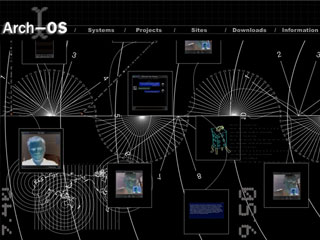
i-500 draws on the Arch-OS experience of developed by i-DAT. The i-500 project is a public art commission for Curtin University’s new Resources and Chemistry Research and Education Buildings. Working in close collaboration with Woods Bagot Architects, as part of the architects project team, the i-500 project team is creating a public artwork to be incorporated into the fabric of the complex with the intention to encourage building users to communicate and collaborate.

http://i-500.org/

i-500 PlanBuilding in progressi-500 i-Chat

i-DAT/Submerge Interactive Architecture Residency.

i-DAT/Submerge Interactive Architecture Residency.

i-500news.jpg
Dr Paul Thomas, Artistic Director of BEAP.(Biennale of Electronic Arts Perth 2007) will be the i-DAT Interactive Architecture Resident artist during the month of July. Thomas will be further developing Arch-OS through the i-500 Project extension. With funding provided by Curtin University the residency will focus on the articulation of the dynamic data generated by the public art instillation to be incorporated into the fabric of the Curtin University of Technology Minerals and Chemistry Research and Education Precinct buildings. http://www.i-500.org

Arch-OS Installation:

Arch-OS Installation:

i-500

(30/11/2005).

Curtin University of Technology – Minerals and Chemistry Research and Education Precinct, Perth – Australia.

Arch-OS is to be integrated into the two new buildings that will form the Minerals and Chemistry Research and Education Precinct at Curtin University. Paul Thomas / Chris Malcolm / Mike Phillips have been commissioned to develop the Public Art Work in collaboration with Woods Bagot Architects, John Curtin Gallery and the Biennale of Electronic Arts Perth (BEAP). http://www.arch-os.com

Arch-OS Installation: Curtin University of Technology

Arch-OS Installation: Curtin University of Technology

2010:

i-500:

Minerals and Chemistry Research and Education Precinct – Perth – Australia.

Arch-OS is to be integrated into the two new buildings that will form the Minerals and Chemistry Research and Education Precinct at Curtin University. Paul Thomas / Chris Malcolm / Mike Phillips have been commissioned to develop the Public Art Work in collaboration with Woods Bagot Architects, John Curtin Gallery and the Biennale of Electronic Arts Perth (BEAP). The new buildings will create an internationally significant Resources Research and Education capability in Western Australia and will house the Department of Applied Chemistry, the Chemistry Centre of W.A., links to the expanded CSIRO Minerals Laboratory, and the Nanochemistry Research Institute.

http://arch-os.com/projects/i-500/