Smarter Planet

Smarter Planet

The Smarter Planet Lab is an innovative collaboration between the BA/BSc (Hons) Digital Art and Technology course, i-DAT (the Digital Art and Technology research group) and information technology giant IBM.

The Smarter Planet Lab is used by Digital Art and Technology students and researchers to develop ideas around a networked culture where everyone and everything is connected. The Smarter Planet Lab is a test bed to explore how The Internet of Things is transforming our relationship with the world, building a more sustainable and stable planet. Originally installed in 213 Babbage Building in 2011 and relocated to 209 Roland Levinsky Building in 2017.

IBM’s concept of a Smarter Planet refers to the way that intelligence is being infused into the systems and processes that make the world work – into things no one would recognise as computers: cars, appliances, roadways, power grids, clothes, even natural systems such as agriculture and waterways. Trillions of digital devices, connected through the Internet, are producing a vast ocean of data. And all this information – from the flow of markets to the pulse of societies – can be turned into knowledge because we now have the computational power and advanced analytics to make sense of it. With this knowledge we can reduce costs, cut waste, and improve the efficiency, productivity and quality of everything from companies to cities.

The technology to build a smarter planet is here, but often instigating the use of these systems into industries that have been around for decades, even hundreds of years, would be complex and involve huge political and economical decisions. It is clear that we need new skills and fields of expertise, new ways of working and thinking. A smarter planet will require a profound shift in management and governance toward far more collaborative approaches. Find out more about the Smarter Planet concept.

The IBM Academic Initiative is a global programme that facilitates the collaboration between IBM and educators to teach students the information technology skills they need to be competitive and keep pace with changes in the workplace. It allows students open access to full versions of hundreds of IBM programmes and software, providing real world experience on industry-proven software. Find out more about the IBM Academic Initiative.

In addition, IBM are offering work placements to Digital Art & Technology students and graduates and offer a prize for work created using their software at the Graduation Ceremony. This unique and valuable partnership is an example of the University’s commitment to supporting new enterprise and dedication to giving students the best possible training to prepare them for the competitive life of the working world.

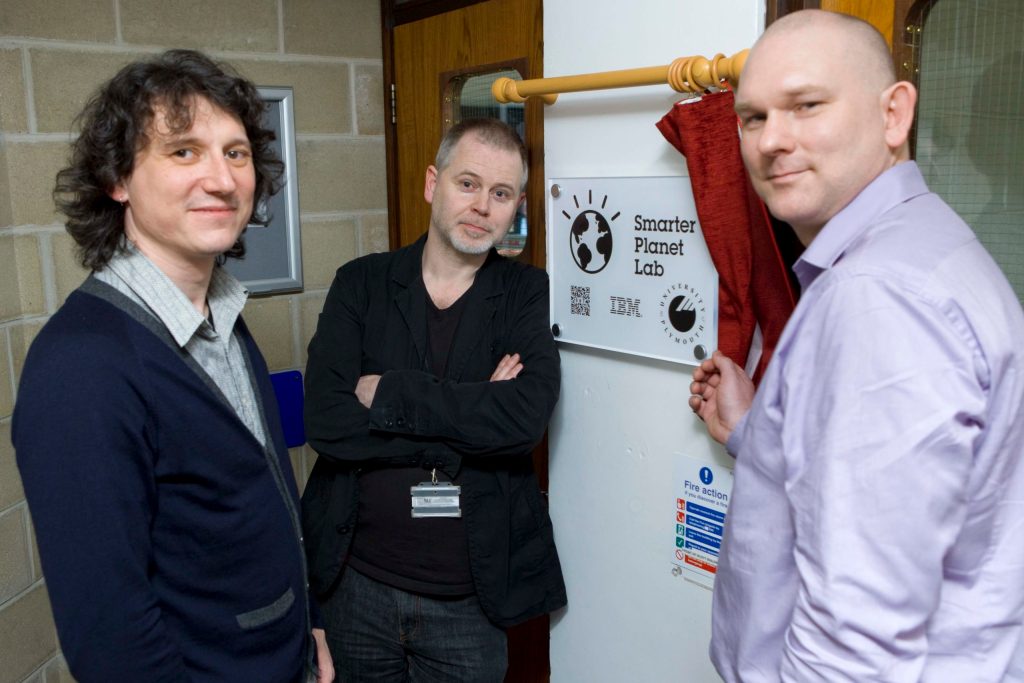
Smarter Planet Lab opening with Brian Innes Watson IoT Developer Advocate), Kevin Farrar (IBM Developer Outreach Leader), Paul Fryer (IBM Academic Initiative Leader) and our very own Nick Marshall (IBM Cloud Infrastructure/Director of NJAM Consultancy) whose placement at IBM Hursley research and development laboratory ignited the relationship.

IoT RoadMap:

Mike Phillips contributes to the Technology Strategy Board Internet of Things Road Mapping Workshop, IoT Special Interest Group and reports. “The Internet of Things (IoT) R&D roadmapping workshop (11-12/07/2012, Loughborough University) was an event co-organised by the Research Councils UK (RCUK) and the Technology Strategy Board (TSB) that brought together participants from both academia and industry, with the objective of mapping “the current research landscape relevant to the Internet of Things, the research and R&D challenges for research institutions and businesses in the Internet of Things space, and the future skills needed and challenges to enable the UK to lead internationally in delivering and realising the IoT capability”.” (local links here: Preparatory Studies Summary Report / Roadmap for Interdisciplinary research- Culture, Creative and Design / Roadmap for interdisciplinary research- Economics and Business / Roadmap for Interdisciplinary Research- Social Sciences / Roadmap for interdisciplinary Research- Technology.

The Internet of Props:

Gianni Corino’s PhD thesis explores the relatively new and fast developing field of investigation known as Internet of Things (IoT), this research starts by looking at the lack of critical and conceptual reflection on the area. With a main research question that challenges the underlying concepts of the IoT, the study develops a performative design framework to critique the field of investigation. The main corpus consists of: 1. speculative inquiry into the ontological dualisms of ‘objects’ and ‘things’ and the emerging social dimension of humans and non-humans; 2. the identification of an ontological-performative model based on the idea of Props; 3. the entanglement of theory and practice to construct a performative design framework, called the Internet of Props, which includes: an enabling platform (Smarter Planet Lab) and a set of design strategies (Transactional Props) to demonstrate and evaluate this model and framework; 4. a combined-evaluation conversational analysis methodology that assesses the performativity of the setting and the Props, through linguistic and socio-behavioural studies.

Thingbook:

Corino, G., Phillips, M. 2016. Thingbook: The Society of All Things (Humans, Animals, Things and Data). DigitCult – Scientific Journal on Digital Cultures. Special Issue. (n.1/2016). https://digitcult.lim.di.unimi.it/index.php/dc/article/view/6: In considering the origin of Things, it is quite conceivable that a designer, reflecting on the mutual affinities of organic and inorganic beings, on their morphological relations, their geographical distribution, cultural succession, social function and other such facts, might come to the conclusion that things had not been independently created, but had descended, like varieties, from other Things. Nevertheless, such a conclusion, even if well founded, would be unsatisfactory, until it could be shown how the innumerable Things, inhabiting this world have been modified, so as to acquire that perfection of structure and coadaptation which justly excites our imagination. In seeking out the future of the origin of Things the authors take a Beaglesque voyage to identify the social, cultural and technological forces which drive the emergence of a Thingbook – a place where all Things converge to define a new phylogenetic tree of networked relationships.

The Smarter Planet initiative is syncretic with i-DAT’s research ethos and methodologies that build on over twenty years of practice-based initiatives and have evolved from a series of ‘Operating Systems’:

ARCH-OS:

Arch-OS represents an evolution in intelligent architecture, interactive art and ubiquitous computing. An ‘Operating System’ for contemporary architecture (Arch-OS, ‘software for buildings’) has been developed to manifest the life of a building and provide artists, engineers and scientists with a unique environment for developing transdisciplinary work and new public art.

BIO-OS:

Bio-OS offers subtle and complex combinations of biological (in its broadest sense) sensing technologies to build data models of a body over time. These data models are stored locally as bioids and collected within the users personal data-base building a biological footprint alongside their individual ecological footprint. The users Avatar can be used to reflect and distribute the biological model.

ECO-OS:

Eco-OS explores ecologies. Eco-OS further develops the sensor model embedded in the Arch-OS system through the manufacture and distribution of networked environmental sensor devices. Eco-OS provides a new networked architecture for internal and external environments. Networked and location aware data gathered from within an environment can be transmitted within the system or to the Eco-OS server for processing.

Barry Sykes @ the IVT…

Barry Sykes @ the IVT…


Friday 18 February
7 – 8pm
Free
Barry Sykes has devised a new lecture for the Immersive Vision Theatre, the repurposed 1960s planetarium set in the middle of the University of Plymouth’s Drake Circus campus, now capable of state of the art virtual reality projections. Sykes will deliver a confessional 3D spectacle loosely based on his artwork, the history of the building and the universe as a whole. Join us for this unique experiment.
Organised for Plymouth Arts Centre
Advance booking essential through PAC.

Bio-OS

Bio-OS

i-DAT receives funding from Arts Council England to continue the development of its core Operating Systems. Bio-OS builds on the OP-SY.com open technical framework to offer the opportunity to collect and manifest biological data. Dynamic visual and sonic experiences derived from human movement will be tailored to improve public understanding and engagement with sporting and athletic activity. In this context Bio-OS and its distribution and engagement mechanisms will provide a open tool for public engagement with artistic practice, information literacy and active engagement leading up to and beyond the 2012 Olympics.

Update: OP-SY.com is now retired but can be found here: https://i-dat.org/op-sy-2/


FlyThru

FlyThru

Volumetric rendering of a Drosophila (or common fruit fly).

Immersive Vision Theatre Project: https://i-dat.org/ivt/

The volumetric rendering is composed of 600 slices at 6 μm digitized through a scanning technique developed at the University of Vienna. Converted to a format readable by 3D visualisation software such as 3DS Max this visualisation was output as a 3D video projection to be experienced in a dome environment. Because of the procedural structure of the 3D model it is possible for a viewer to interact with the image exploring the inner bodily cavities of the fly.

The software used to produce and visualise the volumetric model of the fly was: Drishti and 3d Studio Max and the interaction was enable through OpenSceneGraph.

Developed by i-DAT, TERG University of Plymouth, Theoretical Biology University of Vienna: Musaab Garghouti, Pete Carrs, Peter Smithers, Dr. Brian Metscher.

Boundary Work I

Boundary Work I

i-DAT is collaborating with Boundary Work 1:
Boundary Work I is the first in a series of exhibitions designed to facilitate a survey of work that operates in the space between art and science and as such aims to encourage a dialogue between the sub-disciplines of these fields.
New Media Art can stimulate a mental image of a genre that breeds on techno-aesthetics alone. However, such a view short-changes the diversity of opportunities opened up in recent years through moves such as artists-in-labs programmes and the development of programming tools for artists. More significantly there is a growing public consciousness that evolving technologies hold significant implications for future human cultures. Such developments have assisted in the emergence of wet or living art, the growth of networked and intelligent artefacts, and a vision of the world enabled through new instrumentation designed for the investigation of macro or nano scale material environments. In addition to new genres, supported through access to new technologies, existing established practices in the arts have critiqued or been inspired by the technology and market driven actions in science.
So while science and art are often identified as opposing fields of knowledge technology can be seen as a common driving force in both. This gallery event attempts to draw activities in both of the worlds of art and science together in a dialogue where technology is the common agent.
The exhibition therefore is a representation of work that treads the boundary between art & design and science and an invitation to participate was extended to artists, designers, and researchers in practices particularly relating to science and/or technology.

http://www.transculturetek.com/boundarywork/index.php

FULLDOME UK 2010 – 10th July Plymouth UK

FULLDOME UK 2010 – 10th July Plymouth UK


Welcome to FULLDOME UK 2010. A celebration of the FullDome experience, we present a day of screenings, presentations, discussions and perhaps some realtime performance. The event takes place at the Immersive Vision Theatre (IVT) based at the University of Plymouth on Saturday 10th July 2010 and runs from mid-day until late evening.
The event is free, but numbers are limited so please let us know your interest via email or by using the online form. We will be updating this site with more information on a regular basis, with more details of the screenings and guest speakers coming shortly – go to:
http://www.fulldome.org.uk/


Phylogeny Symposium

Phylogeny Symposium

Practical Symposium 19-21st Feb
Thinking and making on time, place and relationship
A arts/science practical symposium organised by the Royal Botanic Garden Edinburgh, Hamer Dodds and the Ubiquity Journal. A weekend of talks, conversations and making, to explore the concept of phylogenetics and its relevance to cultural art and design practice.
Ecoid demonstration in the Royal Botanic Garden, Edinburgh. Follow the link to Ubiquity…
http://ubiquityjournal.net/

Dr Speed introducesand an ecoid in a pear tree...ecoid

Phylogeny

Phylogeny

Phylogeny: Thinking and making on time, place and relationship

19–21 February 2010 / Royal Botanic Garden Edinburgh

HAMER DODDS: Co-director of Melted Snow

Hamer Dodds is a freelance artist and scientist. He recently co-founded Melted Snow, a design team working in the field of science, art and interpretation.

E-mail: phylogeny@blueyonder.co.uk


Organizers/lead contributors

Chris Cottrell, independent artist

Max Coleman, Royal Botanic Garden Edinburgh

Hamer Dodds, independent artist/scientist

Gerhard Lang, independent artist

Mike Phillips, University of Plymouth

Chris Speed, University of Edinburgh

Alexandra Wortley, Royal Botanic Garden Edinburgh


Background

In October 2009 Hamer Dodds was asked by the Royal Botanic Garden Edinburgh to organize a weekend event as part of the International Year of Biodiversity initiative. The Royal Botanic Garden Edinburgh is widely regarded as being in the top four scientific gardens in the world. It is, literally, a living laboratory. This function needed to be reflected in the workshops over the weekend. The subject of the weekend’s events was phylogeny.

Symposium at the John Hope Gateway building, Royal Botanic Garden of Edinburgh.

Phylogeny is our way of understanding how all living things are connected – the biology of relationships. There are between 5 million and 100 million species on our planet. Amazing though it may seem, it is most likely that they all evolved from a pool of interbreeding ancestors existing some 3000 million years ago.

Darwin’s theory of evolution by natural selection explains how every new organism has slightly different characteristics, which may make it more or less able to survive and reproduce in a given environment. Scientists now know that these characteristics (shape, colour, behaviour, etc.) are largely determined by its genes. Differential survival in different environments propagates and accumulates these genetic differences until each lineage is considered distinct enough to be defined as a new species. Over time, the process has generated a complex network of relationships that can be depicted as a branching diagram – a phylogenetic tree.

Phylogenetic relationships are inferred simply by comparing the characters of organisms. In the past this meant morphological characteristics; nowadays it often means DNA sequences, but the principle is the same: a process of considering which of all the possible phylogenetic trees matches best to the distribution of characteristics in the organisms under consideration. For a small number of species, this process is relatively easy – if you have three species, there are only three possible ways (Fig. 1) they can be related (X and Y are more closely related to one another than to Z, X and Z are more closely related to one another than to Y, or Y and Z are more closely related to one another than to X). For four species there are fifteen possible phylogenies (Fig. 2). For seven there are over ten thousand! This is the reason why most phylogenetic analyses nowadays are carried out using a computer.

The intervention of the computer to support the interpretation and comparison of sequences presents an interesting interface to the plants. Huge data trees become complex signatures for the actual plant and databases become new environments with which to study them. The combination of the constructed Royal Botanic Garden that dates back to the seventeenth century and the digital vocabularies of phylogeny offered an interesting context in which to invite participants. The lens of phylogeny reframed the actual garden as an instrument and allowed discussions and events to explore our complex contemporary relationship with plants.

It was important that the events of the weekend would neither compromise the scientific integrity nor the understanding of the work by both artists and scientists. Dr Alexandra Wortley and Dr Max Coleman provided both the scientific integrity and flexibility of thought needed to achieve these requirements. We felt that it was important to engage the community that visited the garden with a variety of ideas that relied ultimately on the concept of phylogeny. This was achieved with workshops for young children, discussions between artists and scientists, phylogeny eating experiences, interactive art sessions and an exhibition of artworks. The links between scientific data generated by the work of the garden should be explored wherever possible.

Dr Cathy Southworth and Dr Jan Barford, from the University of Edinburgh, developed activities related to phylogeny for primary-school children and Louise Ollie supplied insights into practical art whilst the artist Gerhard Lang installed an artwork in the garden. It was important that all activities were open to everyone. The mini talks allowed for the idea of phylogeny to be used in a wider context than its inventor, Ernst Haeckel, was prone to do. Holding these discussions within a working scientific establishment acted as a catalyst to new ways of thinking as well as providing a beautiful space for walking and contemplating.


Workshops/Events

1. Phylogeny walk (Plant Routes)

2. Root vegetable phylogeny prints

3. Drawing root vegetable phylogenies

4. Phylogeny artworks

5. Installation by Gerhard Lang

6. Practical symposium

7. Kit set constructing phylogenies

8. Alignment activities

9. Mini talks


Phylogeny Images:

Elise Campbell, artist and landscape architect, responding to the discussion through artefacts.


Gerhard Lang introducing his work and interest in biology and form.


Hamer Dodds. Hamer Dodds


Vegetables used in the kids workshop as stamps to construct simple phylogenetic trees.


Gerhard Lang’s installation Flowres of the Forrest recalls the seventeenth-century Scottish folk tune and the botanist George Forrest whose international expeditions contributed to the Royal Botanic Gardens collection.


Arch-OS – VILLAGE SCREEN

Arch-OS – VILLAGE SCREEN

big screen

Arch-OS – VILLAGE SCREEN @ The Glastonbury Festival Big Screens

Aqeel Akbar, Immersive Media Assistant at the Immersive Vision Theatre was selected to join the team of seven artists working on site at the festival. The dynamic visualisations shown on the screen included the Quartz Composer real time Arch-OS data visualization developed in the i-DAT/AHO/Bartlett workshop.

Aqeel's Visualisation

“The Village Screen project was a unique collaboration led by the region’s 2012 Creative Programmer, Glastonbury Festival, Team South West and Relays (Legacy Trust UK programme), and including the UK’s network of Creative Programmers, screen agencies and the BBC’s Live Sites team, brings the Village Screen to Glastonbury for the first time this year. The screens will be used to showcase the work of some of the best new filmmaking talent, digital artists, VJs and games developers from the region and the UK.

The 25m2 screens (there are two of them, back- to- back) will broadcast a mix of short films, archive footage, gaming sessions, classic pop and highlights of the BBC’s coverage of the Festival from 10.00am to 3.00am every day.

Village Screen was coordinated by Richard Crowe, London 2012 Creative Programmer.

e: richard.crowe@london2012.com

www.london2012.com/culture

www.artscouncil.org.uk