
Musica Universalis

Musica Universalis – Music of the Spheres

Originating in greek philosophy, the “music of the spheres” (or musica universalis) comes is a belief that the movements of celestial bodies like the Sun, Moon, and planets create a form of harmony or music—though not one we can hear with our ears. This concept was expanded on by 16th-century astronomer Johannes Kepler, who thought the “music” of the planets spoke to the soul. Even Aristotle weighed in, suggesting that celestial motion might produce sounds we’re so used to hearing that we don’t notice them, like a smith ignoring the clanging of their tools.

“Some thinkers suppose that the motion of bodies of that size must produce a noise, since on our earth the motion of bodies far inferior in size and in speed of movement has that effect. Also, when the sun and the moon, they say, and all the stars, so great in number and in size, are moving with so rapid a motion, how should they not produce a sound immensely great? Starting from this argument and from the observation that their speeds, as measured by their distances, are in the same ratios as musical concordances, they assert that the sound given forth by the circular movement of the stars is a harmony. Since, however, it appears unaccountable that we should not hear this music, they explain this by saying that the sound is in our ears from the very moment of birth and is thus indistinguishable from its contrary silence, since sound and silence are discriminated by mutual contrast. What happens to men, then, is just what happens to coppersmiths, who are so accustomed to the noise of the smithy that it makes no difference to them.”

(Artistotle)


Home | Sound | Holst | Musica Universalis | Scores | Resources

Holst

Gustav Holst

(1874-1934) was a famous English composer, best known for his epic orchestral suite The Planets, written between 1914 and 1917.


The Planets

This seven-movement orchestral suite is a musical depiction of astrological character traits associated with the planets of the Solar System (excluding Earth and Pluto – which hadn’t been discovered at the time). Each movement is a standalone tone poem, characterized by Holst’s intricate orchestration, thematic variety, and dramatic contrasts.

  • Mars, the Bringer of War.
  • Venus, the Bringer of Peace.
  • Mercury, the Winged Messenger.
  • Jupiter, the Bringer of Jollity.
  • Saturn, the Bringer of Old Age.
  • Uranus, the Magician.
  • Neptune, the Mystic.

There’s also a much older idea of the relationship between the planets and music – The Music of the Spheres


Home | Sound | Holst | Musica Universalis | Scores | Resources

Hotwire x Holst

Hotwire x Holst

Hotwire x Holst

Wednesday 4th December 2024

Hotwire~ is an Open Research Lab for playful experimentation with creative technology set up by Andrew Prior and David Strang. There are hotwire nodes in Plymouth, UK and Suzhou, China. We have performed, run workshops, and created installations worldwide. Hotwire is about art + technology, DIY, DIT and DIWO (Doing it Together / Doing it with Others), making / breaking stuff, hacking, creative coding and circuit bending, and more.

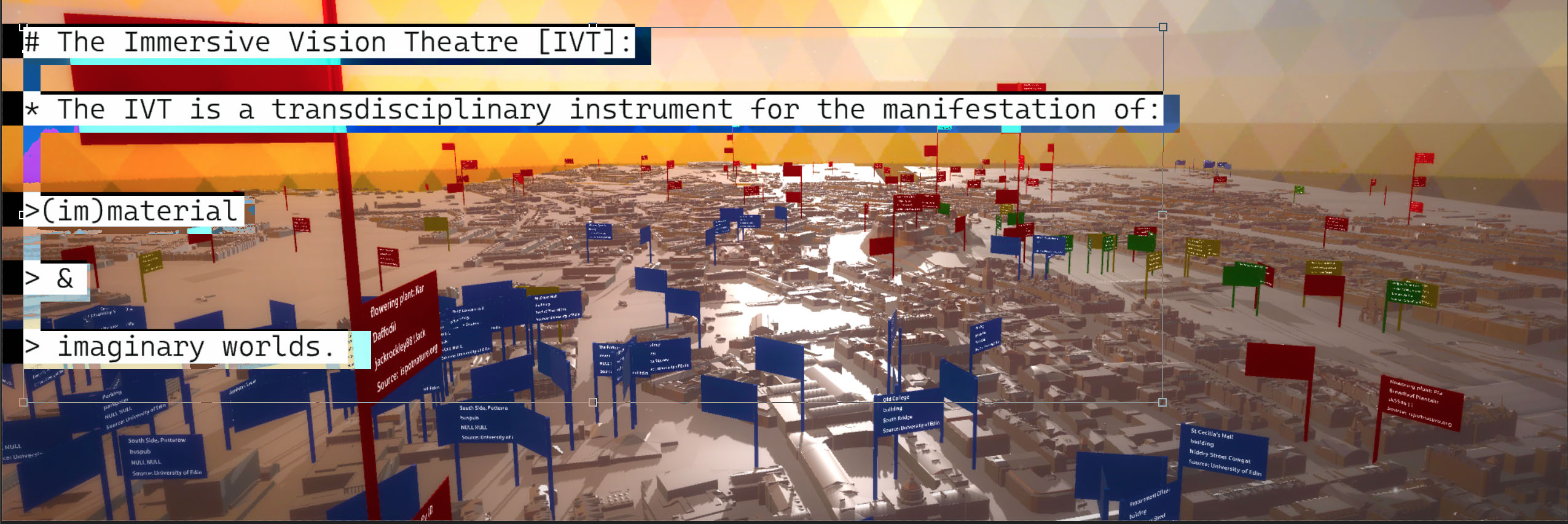
This workshop is part of the Holst Spaceship Earth project, celebrating the 150th anniversary of Gustav Holst. This event is a collaboration with PlayLa.bZ, the University of Plymouth, i-DAT, and Hotwire; and it’s happening at the Immersive Vision Theatre (IVT), a transdisciplinary instrument for the manifestation of (im)material and imaginary worlds.

Overview

In this workshop we’re going to make some sound collages. Sound doesn’t mean ‘music’ necessarily – it includes music, but also: noise, spoken word and anything else you can hear. Some of the sounds we’ll use maybe from existing sources – for example: youtube, websites, archival recordings, or sampling the music of Holst – but we can also use new sounds – poems, quotes, music instruments, handclaps, singing, humming, sound effects…


Home | Sound | Holst | Musica Universalis | Scores | Resources

Sound

Organised Sound

In using the term ‘sound’ instead of music, we’re following the lead of composer Edgard Varese, who called his own music “organized sound.” This side-steps all the conventional requirements of music: to follow certain rhythms, meters, scales, structures and instrumentation. Varese explained: “Indeed, to stubbornly conditioned ears, anything new in music has always been called noise. But after all what is music but organized noises?” (Varese & Wen-Chung, 1966, p. 18 in Berkowitz, 2024)

Adam Eric Berkowitz (2024) “Artificial Intelligence and Musicking: A Philosophical Inquiry.” In Music Perception Volume 41, Issue 5. University of California Press. June 2024

https://online.ucpress.edu/mp/article/41/5/393/200671/Artificial-Intelligence-and-Musicking

Spatialised Sound

We’ll be exploring the affective potential of spatialised sound. Unlike visual phenomena, that we can only see when infront of our eyes, we’re immersed in sound – we can hear behind, above, beside and below us. We can feel sound in our bodies – sound is vibration. And sound moves through 3D dimensional space over time – up/down, left/right, forward/backward. You can even hear when something tips, rolls or spins. To achieve these kinds of effects with media, you need to send sounds in varying volumes to multiple speakers – or you need to record sound spatially to begin with, by using an ambisonic microphone for example.


Home | Sound | Holst | Musica Universalis | Scores | Resources

Yihan Ge

Yihan Ge is a PhD researcher in i-DAT on the CODEX International Postgraduate Research Network.

Born in 1994 in Nanjing, Jiangsu Province, China, I hold dual master’s degrees in design. I earned a bachelor’s degree in Interaction Design from the School of Industrial Design at Nanjing University of the Arts in 2016. After graduation, I worked as a UI designer at Bihui Electronics (2016–2018) and as a designer at Hanqingtang Studio (2018–2019). From 2019 to 2023, I pursued a master’s degree in Art Design at Nanjing University of the Arts, followed by a Master of Arts in Visual Communication Design at Birmingham City University (2021–2022).
My expertise lies in graphic design, video animation, and interactive graphic design. Throughout my academic and professional journey, I have received several accolades, including:

• Third-Class Academic Scholarship (2019)
• Second-Class Academic Scholarship (2020)
• Excellence Award in JD’s “High Energy Creation Camp” Game Phone Design Contest (2020)
• First-Class Academic Scholarship (2021)
• First Prize in the “Internet+” Student Innovation and Entrepreneurship Competition (2021)
• Finalist in the 4th Huang Gongwang Cross-Strait Cultural and Creative Design Competition (2021)
• Publication of “The Interactive Future of Wayfinding Design” in Architecture and Culture (2021, CNKI indexed)
• “Eastern Creative Star” Design Competition Winner (2023)
• Outstanding Advisor Award in the Luminarc Campus Design Competition (2024)

I am passionate about exploring the intersection of design, culture, and technology.

Haoyue Qin

Haoyue Qin(Qin) is a PhD researcher in i-DAT on the CODEX International Postgraduate Research Network. Her research focuses on the integration of traditional Chinese culture into game design from a cross-cultural perspective.

Her research explores how to effectively embed elements of Chinese culture into games, addressing issues of narrative and expression in cultural-themed game projects. The aim is to enable players from diverse cultural backgrounds to understand the essence of Chinese culture while enjoying an immersive and engaging gaming experience.

This research strives to bridge cultural gaps through interactive storytelling and innovative design, contributing to a richer understanding of Chinese culture in the global gaming landscape. It examines various aspects, including game narratives, mechanics, interface interactions, and visual design, to ensure the seamless and meaningful incorporation of cultural elements into games.

Kumi Oda

Kumi is a design researcher and moving image designer. She is currently pursuing a PhD in Digital Art and Technology, focusing on the research theme ‘Playful Communication Design in the Context of Child Healthcare’. This research, employing participatory and co-creative design methods, aims to enhance communication between child patients and healthcare professionals while mitigating medically related mental trauma in children.

Prior to moving to Plymouth, she was a visiting lecturer at Joshibi University of Art and Design, a freelance design researcher at DXL Design Lab in UTokyo, and has extensive experience as a qualitative researcher. In this role, she provided insights to technology companies, helping them develop new products and services informed by user needs.”

Thomas O’Brien

Tom O’Brien is a member of the Immersive Vision Theatre team and a 3rd Year Digital Media Design student.

A photographer and digital artist by heart, Tom works across a range of mediums. He’s created dome productions, radio shows and infographics along concert and corporate photography for Plymouth-based company The Wardrobe Ensemble and charities including Pollenize, Animate and BASICS Devon. During his time at Plymouth University, he’s created meditation-based virtual reality experiences, dome experiences about the mindbending designs of M.C Escher and projection mapped stories of local heritage. He hopes to expand his future work in the immersive sector to a particular focus on healthcare and social experiences.

You can find more of his work here:
https://thomasobrienf37f.myportfolio.com/

Joanna Clarke

Joanna is a Research Assistant in the Entrepreneurial Futures Immersive Project and Assistant Lecturer for Games Arts and Design. Joanna is a 3D generalist and designer who is constantly striving to learn as much as possible within 3D design, she has professional experience working as a 3D designer as well as teaching 3D arts.

Joanna has experience in traditional 3D modelling, texturing and animating across numerous programmes. She also has experience working in Laser Scanning and Photogrammetry, as well as experience in creating within the Unreal and Unity game engines for both personal and professional work.

Shangren Li

Shangren Li is a PhD researcher in i-DAT on the CODEX International Postgraduate Research Network.

“Guided by Tai Chi cultural philosophy and integrated with Extended Reality (XR) technology, my research aims to enhance overall physical and mental well-being through an art healing system that fuses traditional culture with modern technological innovation.”