Dome Fugue v1.0:

Dome Fugue v1.0:

fugue.jpg
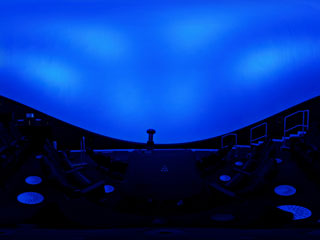
1.30: Sunday 24 February 2008. The Immersive Vision Theatre and i-DAT present the ‘Dome Fugue v1.0’. This is a specially commissioned sonic experience to celebrate the re-birth of the William Day Planetarium as a transdisciplinary instrument for the manifestation of material, immaterial and imaginary worlds. This pre-launch rendering of the ‘Dome Fugue v1.0’ will be performed in the Full Dome using its cutting edge spatialised sound system and accompanied by immersive generative visualisations. ‘Dome Fugue v1.0’ has been composited by i-DAT, researchers in the Nascent Art & Technology Research Group and The Immersive Vision Theatre ‘Domies’. The piece lasts 23 minutes 56.0409053 seconds, a scaled down sidereal period (a single rotation of the Earth relative to the stars). The Dome has seating for 35 people. The newly developed Immersive Vision Theatre was brought to life by the Experiential Learning CETL (Centre for Excellence in Teaching and Learning) under the direction of Dr Ruth Weaver. The future management of the Dome lies with the Centre for Creative Design and Technology, a cross faculty (Arts & Technology) initiative and a transdisciplinary catalyst for innovation to influence the evolution of new creative design practices and strategies.

Dome Fugue v1.0 is part of Voices III the Peninsula Arts Contemporary Music Festival 2008. Friday 22 – Sunday 24 February 2008. http://cmr.soc.plymouth.ac.uk/event.htm

Dome Fugue v1.0:

Dome Fugue v1.0:

1.30: Sunday 24 February 2008. The Immersive Vision Theatre and i-DAT present the ‘Dome Fugue v1.0’. This is a specially commissioned sonic experience to celebrate the re-birth of the William Day Planetarium as a transdisciplinary instrument for the manifestation of material, immaterial and imaginary worlds. This pre-launch rendering of the ‘Dome Fugue v1.0’ will be performed in the Full Dome using its cutting edge spatialised sound system and accompanied by immersive generative visualisations. ‘Dome Fugue v1.0’ has been composited by i-DAT, researchers in the Nascent Art & Technology Research Group and The Immersive Vision Theatre ‘Domies’. The piece lasts 23 minutes 56.0409053 seconds, a scaled down sidereal period (a single rotation of the Earth relative to the stars). The Dome has seating for 35 people. The newly developed Immersive Vision Theatre was brought to life by the Experiential Learning CETL (Centre for Excellence in Teaching and Learning) under the direction of Dr Ruth Weaver. The future management of the Dome lies with the Centre for Creative Design and Technology, a cross faculty (Arts & Technology) initiative and a transdisciplinary catalyst for innovation to influence the evolution of new creative design practices and strategies.
Dome Fugue v1.0 is part of ‘Voices III’ the Peninsula Arts Contemporary Music Festival 2008. Friday 22 – Sunday 24 February 2008. http://cmr.soc.plymouth.ac.uk/event.htm
"Have Dome Will Travel"

"Have Dome Will Travel"

cluny2.jpg

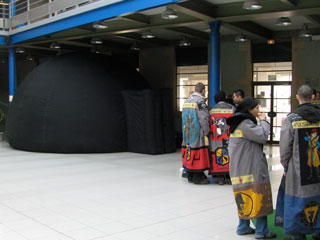
18/12/07: Pete Carss (i-DAT PhD & chief Dome RA), Professor Neil James (Dean of the Faculty of Technology) & Mike Phillips (i-DAT) magically transport a 5 meter inflatable Go-Dome and peripherals all the way to Cluny in Saone-et-Loire, France. The team presented a dome corrected 3D model of the Cluny Abby at the Ecole Nationale Supérieure d’Arts et Métiers, Centre de Enseignement et de Recherche de Cluny. The 3D model, developed by Christian Pare and his team for high resolution stereoscopic, immersive and interactive viewing, was supplied for experimentation within dome environments. The team latter visited the Institut Image in Chalon sur Saone as guests of Christian Pare for a tour of their cutting edge Cave and force feedback systems.

SlidingScale

SlidingScale

13-15/12/06 to 19/01/07:


SEM (Scanning Electron Microscope) / Rapid-prototyping workshop & Looking into the Eye of God seminar. The Bartlett School of Architecture, i-DAT, m-DAT, nascent-research, trans-techresearch. Sliding Scale (13-15/12/06 to 19/01/07) presents a view of our relationship with the peculiar landscapes of digital technology as an ‘ecology’. In exploring these landscapes we navigate through a territory that is disturbed, moist, blurred and vacillating. We are forced to focus on the ‘relationships between’ where process replaces product in importance, just as systems supersede structure. The tools that form these landscapes are harbinger’s for a meaningful ecological (both machinic and natural) audit of specific sites and processes. They demand the development of new strategies and protocols for their users (designers, engineers, architects and artists) and require that the sites, agents, provocateurs, disparate observers and drifters that consume and influence their output critically engage with them.

Download: SlidingScales.pdf