Robert Pepperell

Post Human Condition / HEX /

Robert Pepperell /

[HEX: 1991-1999][Post Human Condition: 1995]/

The Post-Human Condition

This work challenges many of the humanist assumptions of Western philosophy, science and art. It proposes a view of the human condition building on the findings of quantum theory, chaos theory, catastrophe theory, cybernetics, cyberpunk and “New Ageism”, taking into account current scientific and technological developments. The author asserts that as we enter the Post Human era, many of our beliefs are redundant, most obviously the belief in the human being. Historically, the social evolution from the Agricultural era to the Industrial era was accompanied by a cultural shift from theism to humanism. The current shift from the Industrial era to the Technological era brings with it radical changes in cultural values and the impact of high technology and increasing automation is changing the way we think about ourselves and our environment.

Pepperell collaborated with Mike Phillips, following their postgrad at the Slade School of Art (1985-87) to support the networking activities of Roy Ascott.

In the early 1990’s Pepperell joined forces with Miles Visman to form HEX, a multimedia production group, producing games, interactive installations, CD-ROMs and VJ sets.

Bio:

Robert Pepperell studied at the Slade School of Art. He has exhibited at Ars Electronica, the Barbican Gallery, Glasgow Gallery of Modern Art, the ICA, and the Millennium Dome, and published several books, including The Posthuman Condition (1995 and 2003) and The Postdigital Membrane (with Michael Punt, 2000), as well as articles, reviews and papers. He is currently Professor of Fine Art and Head of the Fine Art Department at Cardiff School of Art & Design, where he runs FovoLab (www.fovography.com).

Credits:


Chris Speed

Planetary Fax Works: 1990-91 /

Chris Speed /

1990-91 /

Throughout the 80s  and 90s fax machines were common place in many institutions which provided a relatively ‘open’ channel for digital art practice to reach diverse audiences from galleries to businesses of all types. Three fax works were designed to engage strangers at the end of a fax machine to challenge their ideas of being in a globally connected world.

The three fax works featured in FUTURE HISTORY designed were through a combination of technologies including the desktop publishing tool Aldus Freehand and basic collage to produce a single A4 that combined environmental, temporal and spatial information.

‘Brighton via the Antarctic 1 & 2, were designed specifically for a relationship with the Tourist Information Office of the Falkland Islands. Embedded within both faxes is a message to the receiver, a personal image of someone waving / jumping, an image of the planet Earth, and a set of instructions of how to turn the fax paper into a sundial that would allow the recipient to wave through the planet in the general direction of Brighton, UK. At a prespecified point in time, the fax message invited Sally and Anna to wave back to the artist and collaborators.

IDAHO to WARSAW was a global fax message that was sent to 5 locations across the Earth that were aligned to construct a single ‘cognitive line’ across the planet. The fax visualised the line across a traditional map of the world, and encouraged recipients to consider the existence of other people and locations in a networked moment.

Bio:

Chris Speed is Chair of Design Informatics at the University of Edinburgh. He has a BA in Alternative Practice (Brighton Polytechnic, 1992), a Masters in Design (Goldsmiths 1999), and a PhD from Plymouth University (‘A Social Dimension to Digital Architectural Practice’, 2007). He was a PhD supervisor on the Planetary Collegium and a member of i-DAT.

Chris Speed is Chair of Design Informatics at the University of Edinburgh where his research focuses upon the Network Society, Digital Art and Technology, and The Internet of Things. Chris has sustained a critical enquiry into how network technology can engage with the fields of art, design and social experience through a variety of international digital art exhibitions, funded research projects, books journals and conferences. At present Chris is working on funded projects that engage with the flow of food across cities, an internet of cars, turning printers into clocks and a persistent argument that chickens are actually robots. Chris is a co-organiser and compére for the Edinburgh www.ThisHappened.org events and is co-editor of the journal Ubiquity.

Chris was PI for the TOTeM project investigating social memory within the ‘Internet of Things’ funded by the Digital Economy (£1.4m) and the related Research in the Wild grant: Internet of Second Hand Things; PI for the JISC funded iPhone app Walking Through Time that overlays contemporary Google maps with historical maps; PI for Community Web2.0: creative control through hacking, a £40K feasibility study that explores parallels between virtual society (Internet) and actual society (communities); Co-I to the Sixth Sense Transport RCUK funded Energy project (£900k) which explores the implications for the next generation of mobile computing for dynamic personalised travel planning. He is also PI for the Travel Behaviours network funded by the RCUK Energy theme (£140k) and Co-I to both the EPSRC Creating trust through digital traceability project (Hull) and Learning Energy Systems project (Edinburgh).


Ade Ward

Auto-Illustrator /

Ade Ward/Signwave /

2001 /

Signwave Auto-Illustrator is an experimental, semi-autonomous, generative software artwork and a fully functional vector graphic design application to sit alongside your existing professional graphic design utilities.

Use it to explore a wide range of generative and procedural techniques in the production of your own graphic designs. Discover how easy it is to produce complex designs in an exciting and challenging environment that questions how contemporary software should behave.

Download a demo version using the links above. You will need one of the operating systems above, a fast processor (G3/G4 Macintosh 300MHz, Windows 600MHz), atleast 64MB RAM and a full install of QuickTime 4 or higher. Requires Mac OS 8.6 or higher, built for Mac OS X.

Bio:

SIGNWAVE UK
Suppliers of Quality Software and Media since 1997

Background
Launched in 1997 as an online media exploration and development zone, Signwave began by hosting projects developed by students at i-DAT’s MediaLab Arts. During 1998, Signwave hosted a range of experimental online works dealing with issues of code-based authorship. By 1999, Signwave had become the official branding of a number of Macintosh software products that crossed a fine boundary between software utility and critical artwork. In 2000, Signwave formally became a company based in London, working on a diverse range of projects for individuals, artists, companies and corporations. Over the following years, Signwave focussed it’s attentions on releasing various software products for both Macintosh and Windows based computers.

In 2001, Signwave launched it’s first ever commercial software artwork, Auto-Illustrator. Having previously been in beta for a year and a half (during which time it won awards at Transmediale.01Prix Ars Electronica and REAL Software), it was released commercially on Christmas Day, 2001. Auto-Illustrator continues to be used across the world by graphic designers who appreciate an artistically challenging and stimulating environment.

Other Signwave software products include Autoshop (a generative bitmap graphic editor, released Christmas Day, 2002), Finder Mail (a cut-down OS-integrated POP3 mail client), as well as other smaller, invigorating and stimulating offerings.

Signwave continues to offer specialist software design and production in a range of areas. We write custom desktop software for a wide range of operating systems, and develop media products to satisfy the needs of a wide range of individuals and businesses. Our attitude is that of stimulation and creativity, whether we are working for artists or global corporations.


Auto-Illustrator Tools.

Auto-Illustrator Users Guide Signwave Auto-Illustrator 1.1 PDF.


Donald Rodney Autoicon

FUTURE HISTORY v1.0: Donald Rodney Autoicon.

It’s as though he’s alert to the current debate in the House of Commons chamber. We briefly discuss love, pain and flowers and when I ask him about the internet, he amusingly replies, “Excuse me?” Even with its Y2K interface, Autoicon is a technological wonder. It doesn’t just imagine black people in the future, it preserves them so that they arrive there safely and in their own image.

(2020). ‘Union jack swastikas and space-age braids: Thirteen Ways of Looking – review’, The Guardian, 28 October 2020. Available at: https://www.theguardian.com/artanddesign/2020/oct/28/thirteen-ways-of-looking-review-cultural-identity-herbert-art-gallery-coventry (Accessed: 16 January 2021).

Autoicon is a dynamic internet work and CD-ROM that simulates both the physical presence and elements of the creative personality of the artist Donald Rodney who died from sickle-cell anaemia. The project builds on Donald Rodney’s artistic practice in his later years, when he increasingly began to delegate key roles in the organisation and production of his artwork. Making reference to this working process, AUTOICON is developed by a close group of friends and artists (his partner Diane Symons, Eddie Chambers, Richard Hylton, Virginia Nimarkoh, and Keith Piper) (ironically described as ‘Donald Rodney plc’ who have acted as an advisory and editorial board in the artist’s absence, and who specified the rules by which the ‘automated’ aspects of the project operate. http://www.iniva.org/autoicon/
web
12Capture3
Backstory:

“I can remember the exact location (though the time is vague – early afternoon of 1997) that it became apparent that the body politic of a white middling (class/age) male would be of little interest. On a stretch of road, half way up the A38, just outside Buckfastleigh, frequently travelled with Donald in an ageing 2CV back in 1990, enroute to install Visceral Canker for the TSW 4 Cities Project. Bizarrely I had recently enacted a personal interpretation of this collaboration through my auto-exsanguination following an ulcer burst a year earlier, and this temporality of the body was a factor in the birth of Autoicon. Memories of all that blood (emerging into the twilight from a Cornish gun emplacement, bloodied, damp and freshly electrocuted) conjured up half forgotten conversations with Donald. In particular the one about the ticking clock that marks the passage of time for all sufferers of Sickle-Cell Anaemia – something about a life expectancy of 36/37 years. I had worked with (or like many of the Donald Rodney PLC – for) Donald on many occasions since our time at the Slade School of Art (1985-87). Back then it was the soundscapes for his installation at the ICA and the donation of my work space, drawings and BBC B I/O boards for the cameraman to walk all over when filming his feature on the State of the Art  TV programme.  There were other bits and pieces but most notably Psalms (with Guido Bugmann). Autoicon would seem to consolidate that period of time, it embraced our many conversations of parallel generic histories sitting in front of Bentham’s glassy eyes, gave new meaning to a history of medical data and, like the original Autoicon, engaged playfully with an inevitability. The mid 90’s were the age of the wannabe avatar, VRML showed such promise and cyberspace was almost tangible. To be in it, part of it, breathing the data, was an ambition being played out in media arts projects all over the world. Yet there was something ghostly and hollow about these apparitions, they were, for the most part just pixels, vague representations that could neither feel nor be felt. My hope was that, through Donald’s body of work and body politic the Autoicon marked an avatar upgrade that was both a homage to Bentham’s original and as rich and complex as his vision for his physical body. A 20th Century Autoicon would have to be embrace the flesh as much as it would the trace data that leached from the temporality of its owner. My work has since, from time to time, attempted to explore the relationship between meat and data, A Mote it is…, Exposure and the various projects in Bio-OS have all attempted to capture the physical, projected and data body beyond the simple two dimensional representation. But the Autoicon needed to be Donald Rodney – and so we set about making plans from his hospital bed for an Arts Council England GFA application…”
Mike Phillips, 10/10/14
iniva
Donald Rodney Autoicon CD:
cd
outsidecd
insidecd
backcd
grab2
grab3
grab1

donald.rodney:autoicon v1.0

http://www.iniva.org/autoicon

README AUTOICON is a dynamic artwork that simulates both the physical presence and elements of the creative personality of the artist Donald Rodney who – after initiating the project – died from sickle-cell anaemia in March 1998. It builds on Donald Rodney’s artistic practice in his later years, when he increasingly began to delegate key roles in the organisation and production of his artwork.
Making reference to this working process, AUTOICON is developed by a close group of friends and artists (ironically described as ‘Donald Rodney plc’) who have acted as an advisory and editorial board in the artist’s absence, and who specified the rules by which the automated aspects of the project operate.
This CD-ROM, in parallel to the internet version (http://www.iniva.org/autoicon), is automated by programmed rule-sets and works to continually maintain creative output. Users will encounter a ‘live’ presence through a ‘body’ of data (which refers to the mass of medical data produced on the human body), be able to engage in simulated dialogue (derived from interviews and memories), and in turn affect an auto-generative montage-machine that assembles images collected from the user’s hard-drive (rather like a sketchbook of ideas in flux).

Through AUTOICON, participants can generate new work in the spirit of Donald’s art practice as well as offer a challenge to and critique the idea of monolithic creativity. In this way, the project draws attention to current ideas around human-machine assemblages, dis-embodied exchange and deferred authorship – and raises timely questions over digital creativity, ethics and memorial.
Further information on the artist and his work is included on the CD-ROM.
For more information email autoicon@iniva.org

INSTRUCTIONS
This software requires no specific installation – it is designed to run straight off the CD-Rom. However, it does require a working installation of Apple’s QuickTime 4. The installer is provided on the CD-Rom in a folder called ‘QuickTime 4’. Please ensure you have fully installed QuickTime 4 before trying to use AUTOICON.
To launch the AUTOICON software, insert the CD into your CD-Rom drive. Navigate to the files on the CD-Rom (Macintosh users should double click the icon that appears on your desktop, Windows users should browse inside ‘My Computer’). Double-click the ‘AUTOICON’ application icon.
The software takes a few moments to start up. Once loaded, click the ‘Continue’ button to launch the software. Interact with the AUTOICON by typing text into the field in the centre of the screen. While you engage in a discussion with the AUTOICON, a montage will be derived from bits of images found on your own hard-drive.
The ‘Activities’ menu allows you to view other aspects of the project, including a slideshow and artist biography. You can also choose to watch the montage in progress, or you can examine the software’s internal memory. External links to the AUTOICON web site and for email feedback are also provided.
If you would like to export the generated montage, choose ‘Save As…’ from the ‘File’ menu.
To leave the AUTOICON, go to the ‘File’ menu, and choose ‘Quit’.

MINIMUM SYSTEM REQUIREMENTS
Macintosh:
Power PC Processor (G3/266 pref.)
System 8.0 or later
32mb RAM
Quad-speed CD-Rom Drive
QuickTime 4 (installer provided)
Windows:
Pentium P200 Processor or higher
Windows 95, 98, NT or 2000
32mb RAM
Quad-speed CD-Rom Drive
QuickTime 4 (installer provided)

CREDITS
Software written by Adrian Ward (adrian@signwave.co.uk). Produced by Geoff Cox & Mike Phillips; STAR (Science Technology Arts Research, University of Plymouth), inIVA (Institute of International Visual Arts) and Signwave, with support from the Arts Council of England (New Media Fund). With contributions from Eddie Chambers, Richard Hylton, Angelika Koechert, Virginia Nimarkoh, Keith Piper, Gary Stewart & Diane Symons. Media courtesy of the artist’s estate and Black Audio Film Collective. Thanks to Pete Everett, Dave Grogono, Ruth Kelly, Paul Khera and Elliot Lewis.
Project © Copyright 2000 STAR, inIVA, Signwave & the estate of Donald Rodney.
Autoicon engine © Copyright 2000 Signwave and its licensors.
HTMLField component © Copyright 1998-2000 Doug Holton.
Media © Copyright 1999-2000 various sources.
QuickTime and the QuickTime logo are trademarks used under license.

Published by the Institute of International Visual Arts (inIVA) and STAR.
inIVA,
6-8 Standard Place,
Rivington Street,
London, EC2A 3BE, UK.
Internet: http://www.iniva.org
Tel: +44 20 7729 9616
Fax: +44 20 7729 9509
STAR (Science Technology Art Research)
School of Computing,  University of Plymouth,
Drake Circus, Plymouth, PL4 8AA, UK
Internet: http://www.CAiiA-STAR.net
Tel: +44 1752 232541
Fax: +44 1752 232540

Donald Rodney Autoicon Launch at inIVA:
Invitation:
envelope
envelopeback
xrayinvite

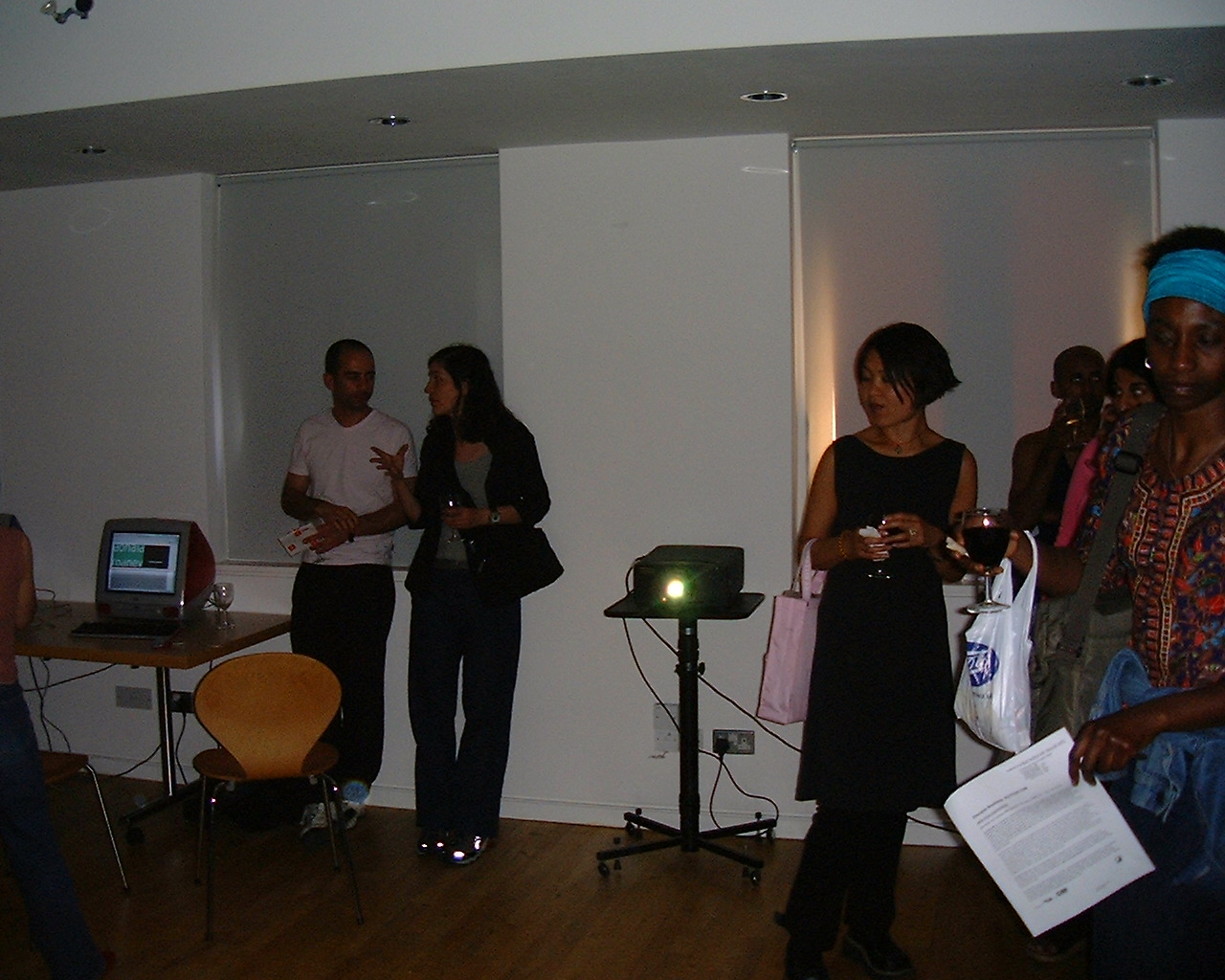
inIVA Launch.
Still not sure what the urination was about. The Dirty Space? Something may have got lost in translation.
DSCF0004 DSCF0005 DSCF0006 DSCF0007 DSCF0008 DSCF0009 DSCF0010 DSCF0011 DSCF0012 DSCF0013

References:
Phillips, M., Cox, G. ‘Donald Rodney – Autoicon. The Death of an Artist’. In EMERGENT FUTURES, Art, Interactivity and New Media / FUTUROS EMERGENTES , Arte Interactividad y Nuevos Medios”. Eds Molina, A. and Landa, K.. ISBN 84-7822-326-6. Alfons el Magnanim. 2000, Valencia.
Phillips, M. Memoria Technica, Donald G Rodney Autoicon. Mediaspace 5,  
‘Autoicon’ CD-Rom & website (collective), exhibition to accompany conference, ‘Race and Digital Space’, Massachusetts Institute of Technology, USA. April 2001. http://cms.mit.edu/race/
‘Autoicon’ CD-Rom (collective), part of exhibition, ‘Art In Motion II’, Santa Monica Museum of Art, Santa Monica CA, USA. 2001.

Adam Montandon & Neil Harbisson

Eyeborg /

Adam Montandon & Neil Harbisson /

2003 /

The collaboration between Adam Montandon and Neil Harbisson resulted in the Eyeborg. Version 1.0 exhibited in the Future History exhibition was produced in Director and uses a webcam to play tones in response to colour input. This was developed into prosthesis worn by Harbisson now that it is surgically attached to his head. Eyeborg allows Harbisson to experience colour through sound, something so subtly demonstrated by Richard Madeley in the extract from Richard and Judy.

Bio:

Adam Montandon: Is a Product Designer and innovator at the University of Southern Denmark (SDU). He is the author of The Awesome Department and Co-founder of Factory of Imagination – Scandinavia’s largest imagination event. As an expert at SDU in Denmark, he has given inspiring keynotes at many universities and events around the world. Highlights include the prestigious Royal Institute of Science in London, Berkeley University in California, Transmedial in Berlin, MipTV in Cannes, TEDxLinz in Austria, and many more.

Neil Harbisson: identifies himself both as a cyborg; he feels he is technology, and as a transpecies; he no longer feels 100% human. His artwork explores identity, human perception, the connection between sight and sound and the use of artistic expression via new sensory inputs.

In 2010 he co­-founded the Cyborg Foundation with Moon Ribas, an international organisation that aims to help humans become cyborgs, defend cyborg rights and promote cyborg art. In 2017 he co-founded the Transpecies Society, an association that gives voice to people with non-human identities, defends the freedom of self-design and offers the creation of new senses and new organs in community.

https://www.cyborgarts.com/

Credits:


Christa Sommerer & Laurent Mignonneau

A-Volve/

Christa Sommerer & Laurent Mignonneau/

1994 /

In the interactive real-time environment “A-Volve” visitors interact with virtual creatures in the space of a water filled glass pool. These virtual creatures are products of evolutionary rules and influenced by human creation and decision.

Designing any kind of shape and profile with their finger on a touch screen, visitors will create virtual three dimensional creatures, that are automatically “alive” and swim in the real water of the pool. The movement and behavior of the virtual creature is decided by its form, how the viewer was designing it on the touch screen.

Behavior in space is, so to speak, an expression of form. Form is an expression of adaptation to the environment.

Form and movement are closely connected, the creatures capability to move will decide its fitness in the pool. The fittest creature will survive longest and will be able to mate and reproduce. The creatures will compete by trying to get as much energy as possible. Thus predator creatures will hunt for prey creatures, trying to kill them.

The creatures also interact with the visitors, by reacting to their hands movement in the water. If a visitor tries to catch a creature, it will try to flee or stays still, if it gets caught. Thus the visitor is able to influence the evolution by for example protection preys against predators. If two strong creatures meet, they can create an offspring and a new creature can be born. It carries the genetic code of its parents. Mutation and cross-over provides a nature-like reproduction mechanism, that follows the genetic rules of Mendel. This newly born offspring will now also react and live in the pool, interacting with visitors and other creatures.

Algorithms, developed by Mignonneau and Sommerer ensure smooth and natural movements and “animal – like” behavior of the creatures. None of the creatures is pre calculated, they are all born exclusively in real time through the interaction of the visitors and the interaction of the creatures . Thus a unlimited variety of forms will be possible, representing human and evolutionary rules. By closely connecting the real natural space of the water to the unreal virtual living space of the creatures, “A-Volve” minimizes the borders between “real” and “unreal”, creating a further step (after “Interactive Plant Growing”) in the search of “Natural Interfaces” and “Real-Time Interaction”


From: http://www.interface.ufg.ac.at/christa-laurent/WORKS/FRAMES/FrameSet.html

Bio:

Christa Sommerer and Laurent Mignonneau are internationally renowned media artists working in the field of interactive computer installation. They are Professors at the University of Art and Design in Linz Austria where they head the Department for Interface Culture at the Institute for Media. Sommerer and Mignonneau previously held positions as Professors at the IAMAS International Academy of Media Arts and Sciences in Gifu, Japan and as Researchers and Artistic Directors at the ATR Media Integration and Communications Research Lab in Kyoto Japan. They also were Visiting Researchers at the MIT CAVS in Cambridge US, the Beckmann Institute in Champaign Urbana, IL, USA and the NTT-InterCommunication Center in Tokyo.


Bill Seaman


generative installation | sample video/audio output from real-time engine (32:9 aspect ratio for two screens)
custom software written in C++/OpenGL, digital video/audio source material

An Engine of Many Senses is a generative computational work exploring the history and potential future of the computer. It includes a series of media elements that combine and recombine over time — 3d images, 2d stills, generative audio, generative media “landscapes”, generative text and video components. The work has a series of internal rules that play out different combinatoric strategies, as drawn from an extensive database of architectural typologies and processes. In particular the work includes a series of allegorical time-based images of computers as well as collaged images from the history of the computer and computational history in general. It also includes diagrams of systems that have never been built. The text in the work is combinatoric and is displayed across a series of moving glyphs. The work is always different in that it never plays out the same media elements and/or processes. It is an example of computational creativity. The work is emergent in nature. It can be show on a series of high-definition screens, or via projections in architectural settings.

The allegorical computers include:
1) world – World Computer – Digital Philosophy for Fredkin/Wolfram
2) binary – Von Neumann Machine – for Turing and von Neumann
3) differential – Abstracted Differential Analyzer – for Vannevar Bush
4) dna – DNA Computer for Michael Conrad and Leonard Adleman
5) neural – Neural Network for Hava Siegelmann and Steven Smale
6) human – Human as Computer for Seaman and Ada Lovelace
7) light – Light Computer (Rössler/Seaman)
8) memex – Memex for Vannevar Bush
9) nano – Nano Computer for Eric Drexler
10) electrochemical – Electrochemical Computer for Gordon Pask
11) quantum – Quantum Computer for David Deutch and Stuart Hemeroff
12) replicant – Self-replicating Computer – for von Neumann
13) spin – Electron (Spin) computer for Rössler/Seaman
14) time – Time Computer (T-Computer) for Scott M.Hithcock
15) analogue – Analogue Computer / Maverick Machine for Gordon Pask
16) wave – Wave Computer/ Well Stirred – for O. E. Rössler and Hugh Everett the 3rd

The Engine of Engines – Toward a Computational Ecology

Bio:

Bill Seaman has explored text, image, sound and interface relationships through diverse technological means since 1979.  In 1995, Seaman coined the term ‘Recombinant Poetics‘ to articulate a set of generative virtual worlds, inhabited and shaped by a flowing of images, video and poetic text and other “intelligently” distributed media objects.  These flows enable the exploration of an advanced recombinance of these objects within a mutable context of neighboring media-elements, media-processes, physical environments and operative code functionalities. Each media-element can be said to convey its own field of meaning. Varying combinations of these fields are experienced through fleeting electronic/environmental relations. The mind-set of the participant represents another active field, and becomes dynamically involved in the construction of meaning. It is through the combination and recombination of these evocative digital fields of meaning, as experienced by an engaged participant, that a new form of poetics emerges. Seaman is currently a professor in Art, Art History & Visual Studies at Duke University where he is exploring Recombinant Poetics and Neosentience Research.

Credits:

Bill Seaman, Principle Investigator and Artist (concept and initial design).

Todd Berreth (programming and additional design).

Thecla Schiphorst

Bodymaps: Artifacts of Touch/

Thecla Schiphorst /

1995-1997 /

“Bodymaps: Artifacts of Touch Bodymaps: Artifacts of Touch (1995-1997), was the first interactive artwork I created that bridged the tactile aspect of my somatics training with my background in computer design^^ The interaction concept is autobiographical in nature and it has an intensely personal, sensual, sometimes disturbing, experiential quality. At the time of Bodymap’s inception the ‘hand’ in HCI was used primarily as a pointing and clicking device or as a text command-based driver of interaction, remaining conceptually divorced from its tactile nature. I was interested in counterpointing the prevalence of goal-directed interaction, exploring interaction that simply ‘made space’ for the existence of experience for its own sake.”

https://pearl.plymouth.ac.uk/handle/10026.1/2177

Bio:

Thecla Schiphorst is a member of the original design team that developed Life Forms, the computer compositional tool for choreography, and collaborated with Merce Cunningham from 1990 to 2005 supporting his creation of new dance with the computer.

This interdisciplinary background forms the basis for her research in embodied interaction, focusing on movement knowledge representation, tangible and wearable technologies, media and digital art, and the aesthetics of interaction. She applies body-based somatic models as articulated in systems such as Laban Movement Analysis to technology design processes within an HCI context. Her research goal is to expand the practical application of embodied theory within technology design. [https://www.sfu.ca/siat/people/research-faculty/thecla-schiphorst.html]

Credits:

Bodymaps: artifacts of Touch, Interactive Video Art Installation, 1995-1997 Artist, Concept and Video Director: Thecia Schiphorst Funding: Canada Council for the Arts, BC Arts Council Project Dates: 1995 – 1997 Artistic Concept, Systems Design: Thecia Schiphorst Software: Ken Gregory, Norm Jaffe, Grant Gregson, Sound Design: Ken Gregory Hardware Engineering: Infusion Systems Table Design: Hanif Jan Mohammed Table Construction: Ewan McNeil Video Director and Video Editing: Thecia Schiphorst Video Performers: Thecia Schiphorst, Nathan Evans Production Assistant: Bernadette MacGregor Documentation Video Editing: Lorna Boschmann

Marcos Novak

Liquid Architecture /

Marcos Novak/

1999 /

“Liquid architecture is an architecture that breathes, pulses, leaps as one form and lands as another. Liquid architecture is an architecture whose form is contingent on the interest of the beholder; it is an architecture that opens to welcome me and closes to defend me; it is an architecture without doors and hallways, where the next room is always where I need it to be and what I need it to be.”

Bio:

Marcos Novak is an architect, artist, composer, and theorist who employs algorithmic techniques to design actual, virtual and hybrid intelligent environments. The self-described transarchitect is seeking to expand the definition of architecture by including electronic space, and originated the concept of liquid architectures in cyberspace and the study of a dematerialized architecture for the new, virtual public domain, the immersive virtual worlds. He is the founder of the “TransArchitectures” events (conferences and exhibitions). He represented Greece at the Venice Biennale 2000 and has exhibited his work in numerous digital media exhibitions. [https://www.centrifuge.org]


Margarete Jahrmann

Ludic Society /

Margarete Jahrmann /

2002 /

mission statement
for emotionally charged methodology and playful epistemology
The ludic society exists to provoke an artistic research discipline best to be addressed as ludic studies
The goal is to provide a playful theoretical starting point of a methodology around the act of play as a state of transformation. Finally games as laboratory situations quit the experimental system into real games by real players
The main argument is the nascence of an experience based emotionally charged reflexion by playing through game systems, to all intents and purposes the il-ludere of illusion in the ludic-society.
Its contributors enforce experiments in game cultures by focusing on the concept of flow in playful situations. As an international association of game practitioners it meets the needs of scholars and artists. It offers unequal opportunities to evolve a new epistemic object around game and play as sustained practice in glitching forms of contemporary lifeworld (Lebenswelt).
The society empowers a variety of arts research projects by its constitution of international and interdisciplinary members. The research practices developed hereby are all oriented on the practices of game cultures. The culture industry propaganda of consumer games lulls players into accepting ideological conditions. Therefore a typology of conversions of games is in the line of development of the society.

Bio:

Margarete Jahrmann is a media epistemologist and an internationally renowned artist on topics of activism, urbanity and play. She is the designer of numerous game art works, research and play installations, performances as well as exhibition and urban games. She holds a professorship for Game Design since 2006 and was co-director of the New Media and Arts department at University of the Arts Zurich from 2000-2006. 2013-2016 she was lecturer Playful Ludic Interfaces, Institute Interface Cultures, University of Arts Linz and since 2011 is senior lecturer for Digital Arts at University of Applied Arts Vienna.

Jahrmann and Max Moswitzer were awarded a distinction in interactive arts, Prix Ars Electronica 2003 for their Game Art work “Nibble Engine” (image), published under the label climax.at. 2004 they received the software arts award transmediale Berlin 2004 for a modification of their Nybble-Engine as Anti-war shooter climax.at.