Data-Scape

Data-Scape

Was once the closest the inside got to the outside was through the creeping of floral patterns onto the living room wallpaper. Penetrating the membrane of the conservatory wall the landscape data feeds now seep into a different kind of fantasy world. The domestic consumption and immersive qualities of the game engine enable a different engagement with the landscape out there in here. This is not a ‘Virtual World’ constructed on the screen, but something more akin to an environmental dashboard or an Albertian window, but with a different kind of perspective. Something like standing in the rain looking at your mobile phones weather forecast, it is raining, you are getting wet, but somehow the digital representation doesn’t feel like that.


Visualising and sonifying the data harvested from the landscape is an essential component of i-DAT’s Operating Systems. Normally the preoccupation is with FullDome immersive environments (Dome-OS) ), as a transdisciplinary instrument for the manifestation of material, immaterial and imaginary worlds. A credible tool for the rendering of these interactive real-time visualisations is the game engine, in particular Blender and Unity 3D. In this workshop the weapon of choice is Unity 3D mainly because, although not open source, it offers a rapid production pathway. For the FullDome environment the use of a FullDome/Fisheye library is required but here the flat screen representation will be used. Feeds from the Ecoids will be read into the game engine template allowing simple interactions and visualisations. Alternative feeds (xml formatted) can also be incorporated.

Patch-Scape

Workshop for the DLA Conference 2013 6-8 June Bernberg, Germany.

Nadia Amoroso, DataAppeal, Andrew Hudson-Smith, University College London, Mike Phillips, Plymouth University, Chris Speed, University of Edinburgh & Katharine Willis, Plymouth University.

Abstract

We should now learn to ‘hook up’ social channels like we do cable for our televisions. Society does not cover the whole any more than the World Wide Web is really worldwide.

(Latour 2005:242)


The Patch-Scape workshop offers a challenging but playful opportunity for participants to generate spatial, social and environmental data derived from the landscape and manage it’s transposition into a series of representational modes using digital technology. Using the Patch-Scape Digital Switchboard, the workshop explores the potential to transpose different data sets into a different 2D and 3D forms.

Exposure

Exposure

ART|SCI CENTER. 


Mike Phillips Lecture + Exhibition Opening: 07-16/03/12.

http://artsci.ucla.edu/?q=events/mike-phillips-lecture-exhibition-opening

Opening March 7
Lecture @ 2pm
Exhibition Openings: 5-7pm
Location: Lecture @ UCLA Broad Art Center, room 5240, Exhibition @ CNSI Gallery


Exposure is an exhibition of work by Mike Phillips, Professor of Interdisciplinary Arts, School of Art & Media at Plymouth University. Mike Phillips is director of i-DAT, a Principal Supervisor for the Planetary Collegium and a supervisor of the Transtechnology Research Groups. His R&D orbits digital architectures and transmedia publishing, and is manifest in a series of ‘Operating Systems’ to dynamically manifest ‘data’ as experience in order to enhance perspectives on a complex world. The year that Eastman Kodak filed for bankruptcy protection was the same year Fujifilm moved from film production to beauty products (1). This did not just mark a technological shift from film grain to nanoparticles but also a massive cultural shift – a shift from capturing the face on film to the embedding of ‘film’ in the face. The thing that once froze the face in an eternal youthful smile is now the anti-aging nanoparticle that preserves the face we wear. Barthes described the face on film as representing “a kind of absolute state of the flesh, which could be neither reached nor renounced”2. Now this absolute state is closer to hand and we will walk around wearing our old photo albums as our face, peeling away the frames like layers of dead skin. Our essence, like Garbo’s, will not degrade or deteriorate.

‘Viewed as a transition’ Exposure explores the deterioration of the flesh through the temporality of the Atomic Force Microscope (AFM). From the 60th of a second exposure of the Kodak Brownie camera to the 20-minute scan of the AFM – the closer the subject the longer the ‘exposure’. Incorporating data from an AFM scan of a basal cell carcinoma Exposure explores the convergence of ideologies constructed around imaging technologies. Through a subtle interaction the viewer conjures up a dynamic data/image of a skin cancer – over exposed to the sun – or the intense light of the camera flashgun.


EXPOSURE

The year that Eastman Kodak filed for bankruptcy protection was the same year Fujifilm moved from film production to beauty products(1). This did not just mark a technological shift from film grain to nanoparticles but also a massive cultural shift – a shift from capturing the face on film to the embedding of ‘film’ in the face. The thing that once froze the face in an eternal youthful smile is now the anti-aging nanoparticle that preserves the face we wear. Barthes described the face on film as representing “a kind of absolute state of the flesh, which could be neither reached nor renounced”(2). Now this absolute state is closer to hand and we will walk around wearing our old photo albums as our face, peeling away the frames like layers of dead skin. Our essence, like Garbo’s, will not degrade or deteriorate. ‘Viewed as a transition’ Exposure explores the deterioration of the flesh through the temporality of the Atomic Force Microscope (AFM). From the 60th of a second exposure of the Kodak Brownie camera to the 20-minute scan of the AFM – the closer the subject the longer the ‘exposure’. Incorporating data from an AFM scan of a basal cell carcinoma Exposure explores the convergence of ideologies constructed around imaging technologies. Through a subtle interaction the viewer conjures up a dynamic data/image of a skin cancer – over exposed to the sun – or the intense light of the camera flashgun.

Exposure builds on a portfolio of data driven work and ‘nano’ art developed by the artist and collaborators, such as Spectre [ˈspɛktə/] (Phillips, M. 2012) (3), A Mote it is… (Phillips, M. 2010) (4) and i-DAT’s Operating Systems (5). These projects explore the ubiquity of data streamed from an instrumentalised world and its potential as a material for manifesting things that lie outside of the normal frames of reference – things so far away, so close, so massive, so small and so ad infinitum. These digital practices use alchemical processes that enable a series of transformations: from data to code to experience to behaviour.

The instruments that now do our seeing for us translate their visions through data. The emergence of digital imaging technologies that provide access to photons from the edge of the universe and the atomic force that binds molecules offer us a whole new vocabulary for articulating the world. Atomic Force Microscope, Scanning Electron Microscope, X-ray computed tomography and the Radio telescope open up new dimensions, as more dimensions are unveiled, more realities are modelled and more truths envisioned. There are (to paraphrase Hamlet) more things in heaven and earth than currently dreamt of in our media philosophy.

“A mote it is to trouble the mind’s eye.” (6) A Mote it is… explored our relationship with technologies that trouble the mind’s eye. Our ability to shift scales, from the smallest thing to the largest thing has been described as the ‘transcalar imaginary’ (7). Hamlet’s Fathers Ghost is seen but not believed and one is left to wonder if it is just the seeing of it that makes it real – its existence totally dependent on the desire of the viewer to see it.  The ‘mote’ or speck of dust in the eye of the mind of the beholder both creates the illusion and convinces us that what we see is real. Something just out of the corner of our minds eye, those little flecks magnified by our desire to see more clearly. Yet the harder we look the more blurred our vision becomes. A ‘mote’ is both a noun and a verb. Middle English with Indo-European roots, its early Christian origins and Masonic overtones describe the smallest thing possible and empower it with the ability to conjure something into being (so mote it be…). This dual state of becoming and being (even if infinitesimally tiny) render it a powerful talisman in the context of nano technology.

i-DAT’s Operating Systems project was initially inspired by early work exploring the potential of spaces recording events that happened within them. Arch-OS was described as a ‘Psychometric’ Architecture, a viral infection of a building that replayed at night the activities that took place during the day. A kind of dreaming architecture. Psychometry… “The concept of objects (or places) seeming to record events and then play them back for sensitive people is generally referred to as psychometry. The objects can be called psychometric objects or token objects” (Morris, R. 1986) (8).

Spectre suggests that the Schauraum, the site of the exhibition, is such an architecture and that the memories of the building are bonded to its fabric by the atomic forces that have now been unlocked by the Atomic Force Microscope. Spectre builds on the collision of A Mote it is… and Psychometric Architecture by drawing on the experiences of Professor Gustav Adolf Schwaiger, the Technical Director of the Austrian Broadcast Corporation, and his collaboration with the famous medium Rudi Schneider in the late 1930’s to the early 1940’s. “G.A. Schwaiger… conducted some private (and rather obscure) experiments with the famous medium Rudi Schneider in the studio of a female painter… In fact the flat could have been right above our exhibition space (Schauraum)” (Fiel, W. 2011) (9). Spectre extends these experiments by replaying the physical remnants of these happenings as captured in the atomic forces binding the dust from their laboratory. The spectres of Schwaiger, Schneider, the painter and the ectoplasm they conjured up are manifest through the Spectre installation.

References:

1: Pico-Collagen (acetyl hydroxyproline), http://and-fujifilm.jp/en/html/skincare/index.html  

2: Roland Barthes The Face of Garbo, Mythologies London: Vintage, 1993; pp. 56-7

3: Phillips, M. ‘spectre [ˈspɛktə/]’, Schauraum. Quartier21 (Electric Avenue), MuseumsQuartier, Museumsplatz 1/5, 1070 Wien, Austria. 27.01-18.03.2012.

4: Phillips, M. ‘A Mote it is…’ Art in the Age of Nano Technology, John Curtin Gallery, Curtin University of Technology, Perth, WA. For exhibition in 02/2010. http://www.i-dat.org/a-mote-it-is-update/  

5 : http://www.i-dat.org/i-dat-launches-op-sycom/

6: Shakespeare, W. Hamlet. Act 1, Scene 1, Line 129.

7. Transcalar Imaginary. “mundus imaginalis traversing the micro, meso, and macro…”  Curated by David McConville. http://www.scoop.it/t/transcalar-imaginary/  

8. Robert L. Morris (Koestler Chair of Parapsychology at the University of Edinburgh 1985 to 2004) in a letter to the artist 21 October 1986.

9. Email correspondence with Wolfgang Fiel. 2011.

Exposure Max patch and source videos-.zip.

With thanks to:

i-DAT.org /
Luis Girao at Arshare /
Professor Genhua Pan at the Wolfson Nanotechnology Laboratory at Plymouth University.

SPECTRE: Exhibition.

SPECTRE: Exhibition.

Eröffnung Opening: 26.01.2012, 19:00 Künstler ist anwesend
Artist is present Ausstellungsdauer Duration: 27.01. – 18.03.
2012 Öffnungszeiten Opening hours: täglich daily 10:00 – 22:00
Kuration Curation: Ruth Schnell and Wolfgang Fiel.
Schauraum quartier21 (Electric Avenue)
MuseumsQuartier
Museumsplatz 1/5
1070 Wien
Vienna, Austria.
www.dieangewandte.at
www.digitalekunst.ac.at
Exhibition Flyer.

Spectre flyer:

Spectre explores the potential of data as material for manifesting things that lie outside our normal frames of reference – so far away, so close, so massive, so small and so ad infinitum. The spectre of Schwaiger is made manifest from the atomic forces that bind the Schauraum dust. A space dreams.

spectre [ˈspɛktə/] noun

1. a visible incorporeal spirit, a ghost, apparition, phantasm, phantasma, phantom.
2. a mental image of some entity of terror or dread: the spectre of death…[C17: from Latin spectrum, literally ‘image, apparition’, from specere ‘to look at’]

Spectre builds on a portfolio of data driven work and ‘nano’ art developed by the artist and collaborators, such as A Mote it is…2 (Phillips, M. 2010) and i-DAT’s Operating Systems1. These projects explore the ubiquity of data streamed from an instrumentalised world and its potential as a material for manifesting things that lie outside of the normal frames of reference – things so far away, so close, so massive, so small and so ad infinitum. These digital practices use alchemical processes that enable a series of transformations: from data to code to experience to behaviour.

The instruments that now do our seeing for us translate their visions through data. The emergence of digital imaging technologies that provide access to photons from the edge of the universe and the atomic force that binds molecules offer us a whole new vocabulary for articulating the world. Atomic Force Microscope, Scanning Electron Microscope, X-ray computed tomography and the Radio telescope open up new dimensions, as more dimensions are unveiled, more realities are modelled and more truths envisioned. There are (to paraphrase Hamlet) more things in heaven and earth than currently dreamt of in our media philosophy.

“A mote it is to trouble the mind’s eye.”3 A Mote it is… explored our relationship with technologies that troubles the mind’s eye. Our ability to shift scales, from the smallest thing to the largest thing has been described as the ‘transcalar imaginary’4. Hamlet’s Fathers Ghost is seen but not believed and one is left to wonder if it is just the seeing of it that makes it real – its existence totally dependent on the desire of the viewer to see it.  The ‘mote’ or speck of dust in the eye of the mind of the beholder both creates the illusion and convinces us that what we see is real. Something just out of the corner of our minds eye, those little flecks magnified by our desire to see more clearly. Yet the harder we look the more blurred our vision becomes. A ‘mote’ is both a noun and a verb. Middle English with Indo-European roots, its early Christian origins and Masonic overtones describe the smallest thing possible and empower it with the ability to conjure something into being (so mote it be…). This dual state of becoming and being (even if infinitesimally tiny) render it a powerful talisman in the context of nano technology.

i-DAT’s Operating Systems5 project was initially inspired by early work exploring the potential of spaces recording events that happened within them. Arch-OS was described as a ‘Psychometric’ Architecture, a viral infection of a building that replayed at night the activities that took place during the day. A kind of dreaming architecture. Psychometry… “The concept of objects (or places) seeming to record events and then play them back for sensitive people is generally referred to as psychometry. The objects can be called psychometric objects or token objects”6 (Morris, R. 1986).

Spectre suggests that the Schauraum is such an architecture and that the memories of the building are bonded to its fabric by the atomic forces that have now been unlocked by the Atomic Force Microscope. Spectre builds on the collision of A Mote it is… and Psychometric Architecture by drawing on the experiences of Professor Gustav Adolf Schwaiger, the Technical Director of the Austrian Broadcast Corporation, and his collaboration with famous medium Rudi Schneider in the late 1930’s to the early 1940’s. “G.A. Schwaiger… conducted some private (and rather obscure) experiments with the famous medium Rudi Schneider in the studio of a female painter… In fact the flat could have been right above our exhibition space (Schauraum).”7 (Fiel, W. 2011).
According to Mulacz’s History of Parapsychology in Austria, “Schwaiger in his research focussed on investigating that ‘substance’ and its effects applied then state-of-the-art apparatus, such as remote observation by a TV set.”8 (Mulacz, P. 2000). That ‘substance’ was the ectoplasm that would emerge from Schneider mouth during their experiments. Spectre extends these experiments by broadcasting live feeds from the space of the Schauraum and simultaneously replaying the physical remnants of these happenings as captured in the atomic forces binding the dust from the their laboratory.
The spectres of Schwaiger and Schneider or the ectoplasm they conjured up are manifest through the Spectre installation.

Mediator

Medium

Muse

Baseline

References:
1: Phillips, M. ‘A Mote it is…’ Art in the Age of Nano Technology, John Curtin Gallery, Curtin University of Technology, Perth, WA. For exhibition in 02/2010. http://www.i-dat.org/a-mote-it-is-update/
2: http://www.i-dat.org/i-dat-launches-op-sycom/
3. Shakespeare, W. Hamlet. Act 1, Scene 1, Line 129.
4. Transcalar Imaginary. “mundus imaginalis traversing the micro, meso, and macro…”  Curated by David McConville. http://www.scoop.it/t/transcalar-imaginary/
5. http://www.i-dat.org/i-dat-launches-op-sycom/
6. Robert L. Morris (Koestler Chair of Parapsychology at the University of Edinburgh 1985 to 2004) in a letter to the artist 21 October 1986.
7. Email correspondence with Wolfgang Fiel. 2011.
8. Mulacz, P. History of Parapsychology In Austria. Notes for a History of Parapsychological Developments in Austria. Paper presented at The Parapsychological Association (PA)  –  the 43rd Annual Convention held from 17th to 20th of August, 2000 in Freiburg i. Br., Germany, hosted by the ‘Institut für Grenzgebiete der Psychologie und Psychohygiene’ (IGPP). http://parapsychologie.info/history.htm#paper

Spectre Max patch and source movies-zip

With thanks to:
Luis Girao for MAXing out…,
Chris Saunders and Dr Simon Lock at i-DAT,
Wolfgang Fiel for the Ghost hunting,
&
Professor Genhua Pan at the Wolfson Nanotechnology Laboratory at Plymouth University, for the AFM scan.

Installation/ Equipment Spec:

3 x Mac Minis.

3 x Samsung SyncMaster P2450H (Resolution will be less than 1920×1080).

3 x tripods

3 x webcams

USB leads from the webcams to the mac minis.

1 x audio system (loud enough to just be heard outside the closed glass box). Will be plugged into the fastest mac mini.

Simple white plinths for the monitors to be just below eye height.

Hundreds of Things

Hundreds of Things

i-DAT, in collaboration with University College Falmouth, invites applications for a 3-year full-time PhD studentship to engage in an applied, practice based research project to explore the potential of smart networked technologies (topically described as the ‘Internet of Things’) to map and evaluate the movement and relationships of people and resources across a geographically distributed communities.
Project overview:

The research will take place through collaborating cultural and heritage venues and regional art galleries distributed across Cornwall. These venues act as active nodes on a dynamic network, linking communities of local residents to a transient community of visitors. They operate as conduits for exchange for ideas, knowledge and physical objects. They also become nodes on more problematic seasonal networks, such as supply chains for food, traffic and amenities (water, electricity and sewerage).

The research will engage in participatory design process through the use ‘provocative prototypes’ or ‘cultural probes’. It will explore the use of smart networked technologies, such as RFID’s, networked sensors, mobile phones, web and embedded technologies, to reveal the complex processes that exist within this networked ecology.

Applicants should therefore have accomplished digital media production skills, such as programming (such as processing, AS3, max msp php, java, etc) and hardware and basic electronics (such as arduino, xbee, RFID, etc).

These processes can be described as a ‘techno-ethnography’ that embraces quantitative data (such as server hits, financial transactions, GPS tracking of artefacts and people, etc) and qualitative data (such as stories, images, audio/visual recordings and conversations).

Supervisory team:
Mike Phillips, Professor of Interdisciplinary Arts and Director of i-DAT (www.i-dat.org) , University of Plymouth, Faculty of Art, Centre for Media Art & Design Research.

Phil Stenton, Professor of Pervasive Media and Associate Dean for Research & Enterprise at the School of Media and Performance at University College Falmouth.

The title of this project ‘Hundreds of Things’ refers to the Anglo-Saxon geographic division of Cornwall into sections of land or ‘Hundreds’. The Hundred was a section of a shire liable to provide for a hundred men under arms, or containing roughly a hundred homesteads. Hundreds were the only widely used administrative unit between the parish and the county in size and acted as a mechanism for passing information across the region.

Today such a system might be described as a dynamic mesh network, with each Hundred being a router node processing and distributing information. Hundreds of Things embraces this forgotten system by recognising the importance of a cultural network that acts as a vehicle for knowledge, trade and social and cultural capital.

The project builds on previous process and technologies deployed by i-DAT, such as Cornwall Culture (CAM’s campaign for Cornwall as a European Region of Culture, http://www.cornwallculture.co.uk/) and https://i-dat.org/op-sy-2/, as well as international collaborative projects such as the ‘Am-I-able Network’ (New Media Research Network fund at Canadian Heritage).

i-DAT has secured the collaboration of IBM Hursley Innovation Centre to develop the Smarter Planet Lab at the University of Plymouth. This project draws heavily on the skills and technologies being jointly developed by i-DAT and IBM within this resource. The ‘Hundreds of Things’ project is synergetic with the IBM Smarter Planet initiative that seeks to embed intelligence and connectivity into distributed objects and provide a technological infrastructure to provide real time data on environments, ecologies, buildings, people, objects and cities.

The Smarter Planet ambition recognises: ‘Trillions of digital devices, connected through the Internet, are producing a vast ocean of data. And all this information – from the flow of markets to the pulse of societies – can be turned into knowledge because we now have the computational power and advanced analytics to make sense of it. With this knowledge we can reduce costs, cut waste, and improve the efficiency, productivity and quality of everything from companies to cities.

The ‘Hundreds of Things’ project will directly link the technologies emerging to facilitate the Smarter Planet rhetoric to the problems of a geographically distributed cultural network to explore a qualitative and quantitative understanding of its regional impact.

Smarter Planet

Smarter Planet

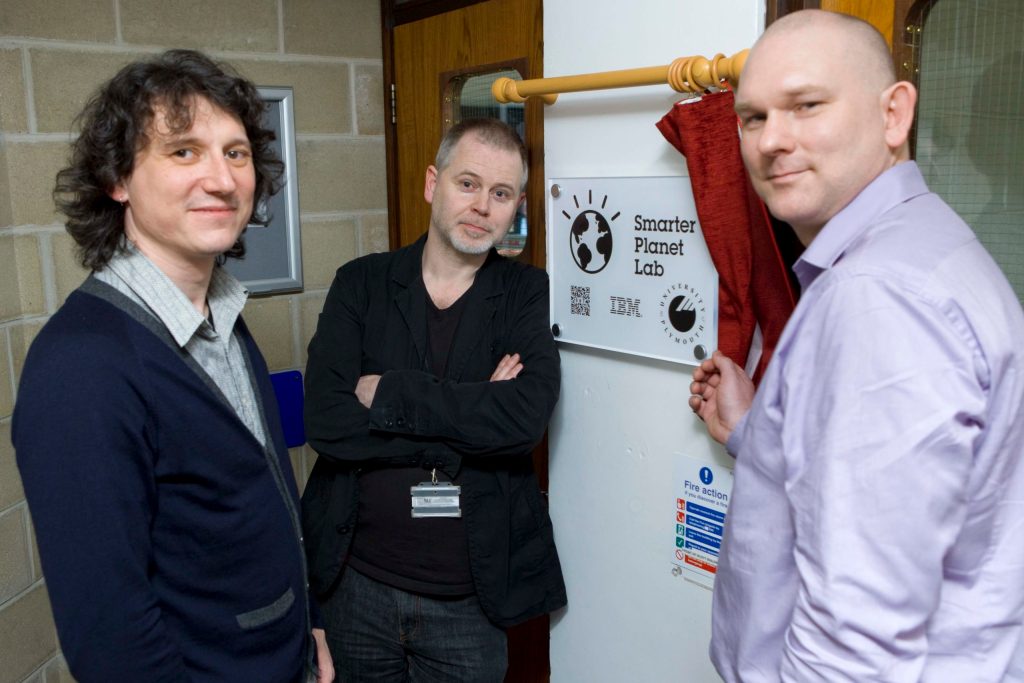
The Smarter Planet Lab is an innovative collaboration between the BA/BSc (Hons) Digital Art and Technology course, i-DAT (the Digital Art and Technology research group) and information technology giant IBM.

The Smarter Planet Lab is used by Digital Art and Technology students and researchers to develop ideas around a networked culture where everyone and everything is connected. The Smarter Planet Lab is a test bed to explore how The Internet of Things is transforming our relationship with the world, building a more sustainable and stable planet. Originally installed in 213 Babbage Building in 2011 and relocated to 209 Roland Levinsky Building in 2017.

IBM’s concept of a Smarter Planet refers to the way that intelligence is being infused into the systems and processes that make the world work – into things no one would recognise as computers: cars, appliances, roadways, power grids, clothes, even natural systems such as agriculture and waterways. Trillions of digital devices, connected through the Internet, are producing a vast ocean of data. And all this information – from the flow of markets to the pulse of societies – can be turned into knowledge because we now have the computational power and advanced analytics to make sense of it. With this knowledge we can reduce costs, cut waste, and improve the efficiency, productivity and quality of everything from companies to cities.

The technology to build a smarter planet is here, but often instigating the use of these systems into industries that have been around for decades, even hundreds of years, would be complex and involve huge political and economical decisions. It is clear that we need new skills and fields of expertise, new ways of working and thinking. A smarter planet will require a profound shift in management and governance toward far more collaborative approaches. Find out more about the Smarter Planet concept.

The IBM Academic Initiative is a global programme that facilitates the collaboration between IBM and educators to teach students the information technology skills they need to be competitive and keep pace with changes in the workplace. It allows students open access to full versions of hundreds of IBM programmes and software, providing real world experience on industry-proven software. Find out more about the IBM Academic Initiative.

In addition, IBM are offering work placements to Digital Art & Technology students and graduates and offer a prize for work created using their software at the Graduation Ceremony. This unique and valuable partnership is an example of the University’s commitment to supporting new enterprise and dedication to giving students the best possible training to prepare them for the competitive life of the working world.

Smarter Planet Lab opening with Brian Innes Watson IoT Developer Advocate), Kevin Farrar (IBM Developer Outreach Leader), Paul Fryer (IBM Academic Initiative Leader) and our very own Nick Marshall (IBM Cloud Infrastructure/Director of NJAM Consultancy) whose placement at IBM Hursley research and development laboratory ignited the relationship.

IoT RoadMap:

Mike Phillips contributes to the Technology Strategy Board Internet of Things Road Mapping Workshop, IoT Special Interest Group and reports. “The Internet of Things (IoT) R&D roadmapping workshop (11-12/07/2012, Loughborough University) was an event co-organised by the Research Councils UK (RCUK) and the Technology Strategy Board (TSB) that brought together participants from both academia and industry, with the objective of mapping “the current research landscape relevant to the Internet of Things, the research and R&D challenges for research institutions and businesses in the Internet of Things space, and the future skills needed and challenges to enable the UK to lead internationally in delivering and realising the IoT capability”.” (local links here: Preparatory Studies Summary Report / Roadmap for Interdisciplinary research- Culture, Creative and Design / Roadmap for interdisciplinary research- Economics and Business / Roadmap for Interdisciplinary Research- Social Sciences / Roadmap for interdisciplinary Research- Technology.

The Internet of Props:

Gianni Corino’s PhD thesis explores the relatively new and fast developing field of investigation known as Internet of Things (IoT), this research starts by looking at the lack of critical and conceptual reflection on the area. With a main research question that challenges the underlying concepts of the IoT, the study develops a performative design framework to critique the field of investigation. The main corpus consists of: 1. speculative inquiry into the ontological dualisms of ‘objects’ and ‘things’ and the emerging social dimension of humans and non-humans; 2. the identification of an ontological-performative model based on the idea of Props; 3. the entanglement of theory and practice to construct a performative design framework, called the Internet of Props, which includes: an enabling platform (Smarter Planet Lab) and a set of design strategies (Transactional Props) to demonstrate and evaluate this model and framework; 4. a combined-evaluation conversational analysis methodology that assesses the performativity of the setting and the Props, through linguistic and socio-behavioural studies.

Thingbook:

Corino, G., Phillips, M. 2016. Thingbook: The Society of All Things (Humans, Animals, Things and Data). DigitCult – Scientific Journal on Digital Cultures. Special Issue. (n.1/2016). https://digitcult.lim.di.unimi.it/index.php/dc/article/view/6: In considering the origin of Things, it is quite conceivable that a designer, reflecting on the mutual affinities of organic and inorganic beings, on their morphological relations, their geographical distribution, cultural succession, social function and other such facts, might come to the conclusion that things had not been independently created, but had descended, like varieties, from other Things. Nevertheless, such a conclusion, even if well founded, would be unsatisfactory, until it could be shown how the innumerable Things, inhabiting this world have been modified, so as to acquire that perfection of structure and coadaptation which justly excites our imagination. In seeking out the future of the origin of Things the authors take a Beaglesque voyage to identify the social, cultural and technological forces which drive the emergence of a Thingbook – a place where all Things converge to define a new phylogenetic tree of networked relationships.

The Smarter Planet initiative is syncretic with i-DAT’s research ethos and methodologies that build on over twenty years of practice-based initiatives and have evolved from a series of ‘Operating Systems’:

ARCH-OS:

Arch-OS represents an evolution in intelligent architecture, interactive art and ubiquitous computing. An ‘Operating System’ for contemporary architecture (Arch-OS, ‘software for buildings’) has been developed to manifest the life of a building and provide artists, engineers and scientists with a unique environment for developing transdisciplinary work and new public art.

BIO-OS:

Bio-OS offers subtle and complex combinations of biological (in its broadest sense) sensing technologies to build data models of a body over time. These data models are stored locally as bioids and collected within the users personal data-base building a biological footprint alongside their individual ecological footprint. The users Avatar can be used to reflect and distribute the biological model.

ECO-OS:

Eco-OS explores ecologies. Eco-OS further develops the sensor model embedded in the Arch-OS system through the manufacture and distribution of networked environmental sensor devices. Eco-OS provides a new networked architecture for internal and external environments. Networked and location aware data gathered from within an environment can be transmitted within the system or to the Eco-OS server for processing.

FlyThru

FlyThru

Volumetric rendering of a Drosophila (or common fruit fly).

Immersive Vision Theatre Project: https://i-dat.org/ivt/

The volumetric rendering is composed of 600 slices at 6 μm digitized through a scanning technique developed at the University of Vienna. Converted to a format readable by 3D visualisation software such as 3DS Max this visualisation was output as a 3D video projection to be experienced in a dome environment. Because of the procedural structure of the 3D model it is possible for a viewer to interact with the image exploring the inner bodily cavities of the fly.

The software used to produce and visualise the volumetric model of the fly was: Drishti and 3d Studio Max and the interaction was enable through OpenSceneGraph.

Developed by i-DAT, TERG University of Plymouth, Theoretical Biology University of Vienna: Musaab Garghouti, Pete Carrs, Peter Smithers, Dr. Brian Metscher.

Ecoid Prototypes

Ecoid Prototypes

Ecoid Prototypes have been used by various organisations at different locations around the globe.
These prototypes were further developed and deployed through the Confluence Project.


Chris Speed, University of Edinburgh, Yamaguchi University, Japan.


Royal Botanic Garden Edinburgh Phylogeny Ubiquity Workshop:

In October 2009 Hamer Dodds was asked by the Royal Botanic Garden Edinburgh to organize a weekend event as part of the International Year of Biodiversity initiative. The Royal Botanic Garden Edinburgh is widely regarded as being in the top four scientific gardens in the world. It is, literally, a living laboratory. This function needed to be reflected in the workshops over the weekend. The subject of the weekend’s events was phylogeny.

“A Mote it is”……

“A Mote it is”……

Art in the Age of Nanotechnology.

A Perth International Arts Festival exhibition – 5 February – 30 April 2010

The unique works developed for art in the age of nanotechnology operate at the intersection of art, science and technology, demonstrating innovative examples of contemporary art and scientific collaboration. The exhibition will comprise of a series of collaborative projects designed to challenge, explore and critique our understanding of the material world and will bring together artists and scientists from the around the world to present new ways of seeing, sensing and connecting with matter that’s miniscule and abstract. art in the age of nanotechnology will feature internationally-recognised artists and scientists such as Christa Sommerer (Austria) & Laurent Mignonneau (France); Paul Thomas (Aus) & Kevin Raxworthy (Aus); Mike Philips (UK); Boo Chapple (Aus) and Victoria Vesna (USA) & James Gimzewski (Scotland).

http://johncurtingallery.curtin.edu.au/

A Mote it is… 

A Mote it is… (from the ‘art in the age of nano technology catalogue).

“A mote it is to trouble the mind’s eye.” (1)

Words spoken by Horartio to describe Hamlet’s father’s ghost. In this Shakespearian play the ghost is seen but not believed and one is left to wonder if it is just the seeing of it that makes it real – its existence totally dependent on the desire of the viewer to see it.  The ‘mote’ or speck of dust in the eye of the mind of the beholder both creates the illusion and convinces us that what we see is real. Something just out of the corner of our minds eye, those little flecks magnified by our desire to see more clearly. Yet the harder we look the more blurred our vision becomes.

A ‘mote’ is both a noun and a verb. Middle English with Indo-European roots, its early Christian origins and Masonic overtones describe the smallest thing possible and empower it with the ability to conjure something into being (so mote it be…). This dual state of becoming and being (even if infinitesimally tiny) render it a powerful talisman in the context of nano technology.

Throughout the last Century we were reintroduced to the idea of an invisible world. The development of sensing technologies allowed us to sense things in the world that we were unaware of (or maybe things we had just forgotten about?). The invisible ‘Hertzian’ landscape was made accessible through instruments that could measure, record and broadcast our fears and desires. Our radios, televisions and mobile phones revealed a parallel world that surrounds us. These instruments endow us with powers that in previous centuries would have been deemed occult or magic.

Our Twenty First Century magic instruments mark a dramatic shift from the hegemony of the eye to a reliance on technologies that do our seeing for us – things so big, small or invisible that it takes a leap of faith to believe they are really there. Our view of the ‘real world’ is increasingly understood through images made of data, things that are measured and felt rather than seen. What we know and what we see is not the same thing – if you see what I mean? The worrying thing is that for a long time we thought the invisible world was made of layers of transparent electromagnetic fields, now through technologies such as the Atomic Force Microscope we are faced with the reality that the ‘invisible’ is actually what constitutes our material world, we can reach out and touch it!

It is our relationship with these technologies that troubles the mind’s eye. Our ability to shift scales, from the smallest thing to the largest thing has been described as the ‘transcalar imaginary’ (2). In this context astronomer Carl Sagan described the Earth as a “mote of dust, suspended in a sunbeam.” (3) The famous image taken from Voyager 1 in 1990 shows the planet suspended in an infinite Universe. A mote that seems so large to us, but which is in fact so cosmologically small, disturbs our sensibilities and desire for order in our world.

A Mote it is… dev:

A Mote it is… install:

Documents:

Art in the Age of Nanotechnology Catalogue.

Art in the Age of Nanotechnology Flyer/Symposium.

About A Mote it is…:

A Mote it is… is constructed from data captured by an AFM (Atomic Force Microscope) from a ‘mote’ or piece of dust extracted from the artist’s eye. The whirlwind of data projected within the gallery is rendered invisible by the gaze of the viewer. The more we look the more invisible it becomes – look away and it re-emerges from the maelstrom of data. A ghost of the mote can be seen in viewers peripheral vision but never head on. – if you see what I mean?

Notes:

1: Shakespeare, W. Hamlet. Act 1, Scene 1, Line 129.
2: http://www.twine.com/twine/12vx9k6qs-2zp/transcalar-imaginary
3: Sagan, C. 1994,Pale Blue Dot, Random House. p6

Many thanks to:

Lee Nutbean and Justin Roberts at i-DAT.
Professor Genhua Pan and Yuqing Du at the Wolfson Nanotechnology Laboratory at University of Plymouth.

AFM Raw Data:

X (µm)  Y (nm)

       0  12.116

   0.019  12.562

   0.039  13.243

   0.058  13.009

   0.078  13.009

   0.097  12.797

   0.117  12.586

   0.136  12.375

   0.156  11.929

   0.175  11.929

   0.195  11.717

   0.214  11.717

   0.234  12.163

   0.253  11.952

   0.273  11.952

   0.292  11.741

   0.312  11.741

   0.331  11.529

   0.351  11.295

    0.37  11.318

    0.39  11.318

   0.409  11.764

   0.429  11.318

   0.448  11.529

   0.468  11.318

   0.487  11.553

   0.507  11.553

   0.526  11.764

   0.546  11.553

   0.565  11.788

   0.585  11.999

   0.604  11.999

   0.624  12.022

   0.643   12.68

   0.663  13.126

   0.682  13.337

   0.702  13.126

   0.721  13.361

    0.74  13.784

    0.76  13.807

   0.779   14.23

   0.799  14.018

   0.818  14.253

   0.838  14.464

   0.857  14.699

   0.877  14.699

   0.896  14.699

   0.916  15.357

   0.935  15.592

   0.955   15.38

   0.974   15.38

   0.994  15.592

   1.013  16.038

   1.033  16.038

   1.052  16.484

   1.072  16.484

   1.091  16.719

   1.111  17.376

    1.13  17.822

    1.15  17.822

   1.169  17.611

   1.189  17.822

   1.208    17.4

   1.228    17.4

   1.247    17.4

   1.267    17.4

   1.286  17.846

   1.306  17.634

   1.325  17.634

   1.345  17.869

   1.364  17.869

   1.384  17.869

   1.403  18.081

   1.423  18.315

   1.442  18.104

   1.461  17.658

   1.481  17.893

     1.5  18.104

    1.52  18.104

   1.539  18.104

   1.559  18.128

   1.578  17.893

   1.598  18.128

   1.617  18.128

   1.637  18.128

   1.656  18.574

   1.676  18.809

   1.695  18.574

   1.715  18.574

   1.734   19.02

   1.754  19.255

   1.773  19.043

   1.793  19.255

   1.812  19.489

   1.832  19.489

   1.851  19.278

   1.871  19.278

    1.89  19.936

    1.91  19.936

   1.929   20.17

   1.949  20.382

   1.968  20.382

   1.988  20.828

   2.007  21.063

   2.027  21.274

   2.046  21.274

   2.066  21.298

   2.085  21.955

   2.105  22.824

   2.124   23.27

   2.143  23.059

   2.163  23.293

   2.182  23.059

   2.202  22.636

   2.221  22.847

   2.241  22.847

    2.26  23.082

    2.28  23.082

   2.299  23.528

   2.319  23.528

   2.338  23.763

   2.358  24.209

   2.377  24.209

   2.397  24.209

   2.416  24.209

   2.436  24.444

   2.455  24.444

   2.475  24.444

   2.494  24.655

   2.514  24.444

   2.533   24.89

   2.553   24.89

   2.572  25.125

   2.592  25.125

   2.611  24.914

   2.631  25.125

    2.65  25.125

    2.67   25.36

   2.689  25.148

   2.709   25.36

   2.728  24.914

   2.748  24.702

   2.767  24.937

   2.787  24.702

   2.806  24.937

   2.826  24.937

   2.845  25.172

   2.864  25.172

   2.884  24.961

   2.903  25.383

   2.923  25.407

   2.942  26.064

   2.962  25.853

   2.981   26.51

   3.001  26.722

    3.02   26.51

    3.04  26.745

   3.059  26.745

   3.079  26.745

   3.098   26.98

   3.118  27.191

   3.137  27.426

   3.157  27.637

   3.176  28.976

   3.196  29.633

   3.215  29.187

   3.235  29.187

   3.254  29.187

   3.274  28.765

   3.293  28.765

   3.313  29.211

   3.332  29.211

   3.352  29.211

   3.371  29.211

   3.391  29.657

    3.41  29.892

    3.43  29.892

   3.449  30.103

   3.469  30.127

   3.488  30.127

   3.508  30.127

   3.527  30.338

   3.547  30.361

   3.566  30.361

   3.585  30.807

   3.605  30.573

   3.624  30.573

   3.644  31.019

   3.663  31.019

   3.683  30.807

   3.702  31.042

   3.722  31.254

   3.741  31.042

   3.761  31.042

    3.78  31.277

     3.8  31.277

   3.819  31.488

   3.839  31.277

   3.858  31.066

   3.878  31.277

   3.897  31.066

   3.917  31.066

   3.936  31.512

   3.956  31.301

   3.975  31.301

   3.995  31.747

   4.014  31.747

   4.034  31.982

   4.053  31.982

   4.073  32.428

   4.092  32.216

   4.112  32.216

   4.131  32.428

   4.151  32.428

    4.17  32.662

    4.19  32.451

   4.209  32.662

   4.229  32.897

   4.248  32.662

   4.268  33.109

   4.287  33.343

   4.306  33.343

   4.326  33.555

   4.345   33.79

   4.365   33.79

   4.384  34.024

   4.404  34.236

   4.423  34.682

   4.443  34.682

   4.462  34.682

   4.482  35.128

   4.501  35.128

   4.521  35.152

    4.54  34.917

    4.56  35.363

   4.579  35.598

   4.599  35.598

   4.618  36.044

   4.638   36.49

   4.657   36.49

   4.677  36.044

   4.696  36.701

   4.716  38.909

   4.735  45.976

   4.755  58.304

   4.774  77.253

   4.794 100.594

   4.813 125.273

   4.833 149.505

   4.852 172.635

   4.872 194.425

   4.891 215.582

   4.911 235.189

    4.93 253.457

    4.95 271.092

   4.969 288.045

   4.989 304.576

   5.008 320.426

   5.027 335.642

   5.047 350.623

   5.066 364.265

   5.086 377.274

   5.105 389.578

   5.125 400.591

   5.144  409.42

   5.164 415.807

   5.183 417.568

   5.203   413.6

   5.222 404.137

   5.242 390.259

   5.261 373.564

   5.281 360.344

     5.3  351.75

    5.32 347.148

   5.339 345.598

   5.359 346.913

   5.378 350.881

   5.398 356.611

   5.417 361.917

   5.437 366.754

   5.456 370.065

   5.476 371.826

   5.495 372.484

   5.515 373.165

   5.534 373.165

   5.554 373.376

   5.573 373.165

   5.593 373.165

   5.612 372.507

   5.632  371.85

   5.651 371.192

   5.671 369.431

    5.69 367.013

    5.71 363.279

   5.729 357.338

   5.748  349.19

   5.768 341.489

   5.787 336.205

   5.807 332.894

   5.826 331.157

   5.846 330.711

   5.865 331.368

   5.885 333.364

   5.904 335.994

   5.924 339.751

   5.943 343.508

   5.963 347.688

   5.982 352.313

   6.002  356.07

   6.021 360.039

   6.041  364.43

    6.06 368.398

    6.08 372.155

   6.099 375.231

   6.119 377.673

   6.138 379.646

   6.158 380.749

   6.177 382.088

   6.197 382.534

   6.216 383.191

   6.236 383.638

   6.255 384.506

   6.275 384.929

   6.294 385.375

   6.314 385.375

   6.333 385.164

   6.353  384.53

   6.372 383.661

   6.392 384.318

   6.411 385.845

    6.43 388.052

    6.45 390.259

   6.469 392.678

   6.489 394.674

   6.508   396.2

   6.528 396.881

   6.547 395.566

   6.567 393.359

   6.586 390.283

   6.606 387.629

   6.625 384.999

   6.645 382.393

   6.664 380.186

   6.684 377.767

   6.703 374.902

   6.723 371.592

   6.742 367.412

   6.762  362.81

   6.781 357.738

   6.801 353.112

    6.82 348.275

    6.84 343.649

   6.859 339.258

   6.879 335.736

   6.898 332.213

   6.918 328.903

   6.937 324.277

   6.957 317.232

   6.976 309.531

   6.996 302.275

   7.015 296.099

   7.035 290.393

   7.054 285.321

   7.074 280.484

   7.093 275.412

   7.113  270.81

   7.132 267.288

   7.151 266.395

   7.171 268.391

    7.19 273.017

    7.21  279.85

   7.229  288.21

   7.249 296.146

   7.268 303.425

   7.288  310.47

   7.307 316.434

   7.327 322.375

   7.346 327.447

   7.366 331.861

   7.385 335.149

   7.405 337.356

   7.424 338.459

   7.444  339.14

   7.463  339.14

   7.483 338.906

   7.502 338.694

   7.522 338.694

   7.541  339.14

   7.561 339.821

    7.58 340.925

     7.6 341.794

   7.619 342.897

   7.639 343.578

   7.658 344.682

   7.678 345.551

   7.697 347.101

   7.717 347.993

   7.736  348.65

   7.756 349.308

   7.775 349.754

   7.795 349.989

   7.814 349.989

   7.834 351.092

   7.853 351.539

   7.872  351.75

   7.892 351.985

   7.911 351.092

   7.931 349.777

    7.95 348.909

    7.97 347.805

   7.989  346.49

   8.009 344.964

   8.028 344.072

   8.048  343.86

   8.067 343.203

   8.087 342.757

   8.106 343.203

   8.126 344.095

   8.145 345.199

   8.165 346.748

   8.184 348.298

   8.204 350.059

   8.223 352.032

   8.243 354.474

   8.262 356.892

   8.282 359.311

   8.301 361.964

   8.321 364.618

    8.34 367.694

    8.36 371.873

   8.379 378.495

   8.399 386.831

   8.418 396.764

   8.438 408.222

   8.457 420.339

   8.477 431.352

   8.496 441.261

   8.516 450.066

   8.535 457.557

   8.555  464.39

   8.574 469.908

   8.593  474.98

   8.613 479.817

   8.632 484.231

   8.652 488.857

   8.671 493.272

   8.691 498.109

    8.71 503.181

    8.73 508.253

   8.749 513.325

   8.769 518.162

   8.788 523.234

   8.808 528.094

   8.827  532.72

   8.847 536.454

   8.866 538.896

   8.886 540.211

   8.905 540.868

   8.925 541.761

   8.944 542.418

   8.964 543.099

   8.983 543.757

   9.003 544.203

   9.022 544.414

   9.042 544.203

   9.061 543.991

   9.081 543.099

     9.1 541.784

    9.12 540.023

   9.139 538.943

   9.159 537.839

   9.178 537.182

   9.198 537.393

   9.217 538.074

   9.237 538.943

   9.256 540.281

   9.276 541.831

   9.295 542.935

   9.314 544.038

   9.334 545.565

   9.353 546.668

   9.373  547.56

   9.392 548.453

   9.412  549.11

   9.431 549.768

   9.451 550.003

    9.47 550.449

    9.49  550.66

   9.509  550.66

   9.529 550.449

   9.548 550.237

   9.568  549.58

   9.587 548.711

   9.607 547.161

   9.626 545.189

   9.646 542.324

   9.665 538.802

   9.685 535.068

   9.704   531.1

   9.724  526.92

   9.743 522.529

   9.763 517.457

   9.782 513.066

   9.802 509.309

   9.821 506.445

   9.841 504.472

    9.86 502.946

    9.88 502.946

   9.899 503.392

   9.919 504.261

   9.938 504.707

   9.958 504.496

   9.977  504.05

   9.997 502.312

  10.016 500.762

  10.035 499.893

  10.055 499.236

  10.074 498.132

  10.094 496.583

  10.113 495.056

  10.133 491.745

  10.152 487.801

  10.172 484.701

  10.191 481.625

  10.211 479.864

   10.23 478.784

   10.25  477.68

  10.269  477.68

  10.289  477.68

  10.308 478.126

  10.328 478.784

  10.347  479.23

  10.367  480.78

  10.386 482.541

  10.406 485.405

  10.425 488.505

  10.445 492.027

  10.464 495.549

  10.484 499.306

  10.503 503.486

  10.523 506.586

  10.542 508.769

  10.562 508.558

  10.581 507.032

  10.601 503.721

   10.62 499.753

   10.64 495.808

  10.659 491.839

  10.679 487.448

  10.698 483.034

  10.717 479.512

  10.737 475.567

  10.756 472.256

  10.776 469.837

  10.795 467.207

  10.815 465.212

  10.834 463.685

  10.854  462.37

  10.873 461.055

  10.893 459.294

  10.912 457.087

  10.932 453.353

  10.951 449.174

  10.971 444.759

   10.99 439.922

   11.01 435.085

  11.029 430.013

  11.049 425.387

  11.068 420.996

  11.088 416.582

  11.107 412.848

  11.127 409.984

  11.146 407.565

  11.166 405.593

  11.185 404.724

  11.205 404.066

  11.224 403.174

  11.244 402.094

  11.263 400.333

  11.283 399.018

  11.302 397.914

  11.322 398.125

  11.341 398.125

  11.361 397.703

   11.38 396.811

    11.4 396.388

  11.419 395.496

  11.438 394.181

  11.458 392.866

  11.477 390.236

  11.497  387.16

  11.516 383.215

  11.536 378.378

  11.555 371.991

  11.575 364.289

  11.594 356.141

  11.614 347.101

  11.633 337.638

  11.653 327.963

  11.672 320.027

  11.692 314.086

  11.711 309.695

  11.731 307.276

   11.75 305.938

   11.77  305.28

  11.789 304.623

  11.809 304.646

  11.828 304.858

  11.848 304.858

  11.867 304.646

  11.887 303.989

  11.906 302.885

  11.926 301.124

  11.945  298.94

  11.965 296.076

  11.984 292.765

  12.004 290.135

  12.023 287.059

  12.043 283.748

  12.062 279.357

  12.082 272.759

  12.101  262.85

  12.121 249.184

   12.14 231.573

  12.159 211.308

  12.179 188.414

  12.198  163.97

  12.218 142.391

  12.237 125.226

  12.257 112.452

  12.276 102.966

  12.296  96.367

  12.315  91.084

  12.335   87.35

  12.354  85.143

  12.374  83.171

  12.393  81.644

  12.413  80.541

  12.432  79.883

  12.452  79.226

  12.471  78.568

  12.491  78.357

   12.51  78.122

   12.53  77.911

  12.549  78.146

  12.569  78.146

  12.588  78.146

  12.608  77.934

  12.627  77.934

  12.647  77.934

  12.666  77.934

  12.686  78.592

  12.705  78.381

  12.725  78.615

  12.744  78.827

  12.764  78.827

  12.783  78.827

  12.803   78.85

  12.822  79.062

  12.842  79.508

  12.861  79.508

   12.88  79.743

    12.9  79.954

  12.919  80.189

  12.939  80.189

  12.958  80.635

  12.978  80.635

  12.997  80.846

  13.017  80.635

  13.036  81.081

  13.056  81.081

  13.075  81.527

  13.095  81.527

  13.114  81.762

  13.134  82.208

  13.153  81.973

  13.173  81.997

  13.192  81.997

  13.212  81.762

  13.231  81.785

  13.251  82.232

   13.27  82.443

   13.29  82.678

  13.309  82.678

  13.329  82.678

  13.348  82.889

  13.368  82.912

  13.387   83.57

  13.407  84.439

  13.426  84.674

  13.446  84.674

  13.465  84.251

  13.485  83.805

  13.504  83.359

  13.524  83.593

  13.543  83.593

  13.563  83.147

  13.582  82.936

  13.601  83.382

  13.621  83.382

   13.64  83.171

   13.66  83.617

  13.679  83.617

  13.699  83.828

  13.718  83.617

  13.738  83.617

  13.757  83.852

  13.777  83.852

  13.796  84.298

  13.816  84.509

  13.835  84.955

  13.855   85.19

  13.874   85.19

  13.894   85.19

  13.913  85.425

  13.933  85.871

  13.952  85.636

  13.972  85.636

  13.991  86.082

  14.011  86.106

   14.03  86.529

   14.05  86.317

  14.069  86.552

  14.089  86.317

  14.108  86.552

  14.128  86.787

  14.147  87.444

  14.167  87.444

  14.186  87.891

  14.206  88.102

  14.225  87.891

  14.245  87.891

  14.264  88.125

  14.283  88.125

  14.303  87.914

  14.322  87.914

  14.342   88.36

  14.361  88.571

  14.381  88.571

    14.4  89.464

   14.42  89.699

  14.439  89.464

  14.459  89.464

  14.478   89.91

  14.498  89.933

  14.517  89.699

  14.537  89.933

  14.556  89.487

  14.576  89.276

  14.595  89.276

  14.615  89.511

  14.634  89.511

  14.654  89.511

  14.673  89.722

  14.693  89.746

  14.712  89.746

  14.732  89.746

  14.751  90.192

  14.771  89.746

   14.79  89.534

   14.81  89.534

  14.829  89.769

  14.849  89.769

  14.868  89.769

  14.888   89.98

  14.907  90.215

  14.927  90.215

  14.946  90.004

  14.966  90.215

  14.985  90.215

  15.004  90.239

  15.024   90.45

  15.043   90.45

  15.063  90.685

  15.082  91.131

  15.102  91.342

  15.121  91.342

  15.141  91.342

   15.16  92.023

   15.18  92.023

  15.199  92.235

  15.219  92.681

  15.238  92.681

  15.258  92.704

  15.277  92.916

  15.297  93.362

  15.316  93.596

  15.336  93.808

  15.355  93.808

  15.375  94.043

  15.394  94.043

  15.414  94.254

  15.433  94.489

  15.453    94.7

  15.472  94.724

  15.492  95.146

  15.511  95.381

  15.531  95.381

   15.55  95.616

   15.57  95.616

  15.589  95.827

  15.609  95.827

  15.628  96.273

  15.648  95.851

  15.667  95.616

  15.687  95.639

  15.706  95.851

  15.725  96.085

  15.745  95.639

  15.764  95.639

  15.784  95.874

  15.803  95.639

  15.823  95.428

  15.842  95.663

  15.862  95.451

  15.881  95.217

  15.901  95.451

   15.92  95.663

   15.94  95.451

  15.959  95.451

  15.979  95.686

  15.998  95.475

  16.018  95.475

  16.037  95.686

  16.057  95.686

  16.076  95.686

  16.096  95.921

  16.115  96.156

  16.135  96.579

  16.154  96.367

  16.174  96.602

  16.193  97.048

  16.213  97.048

  16.232  97.048

  16.252  97.494

  16.271  97.494

  16.291  97.706

   16.31  97.494

   16.33  98.152

  16.349  98.175

  16.369  98.621

  16.388  99.044

  16.408  99.068

  16.427  99.279

  16.446  99.279

  16.466   99.96

  16.485  99.725

  16.505  99.725

  16.524 100.406

  16.544 100.406

  16.563 100.406

  16.583 100.617

  16.602 101.064

  16.622 101.298

  16.641 101.744

  16.661 102.191

   16.68 101.956

    16.7 101.979

  16.719 102.191

  16.739 102.637

  16.758 102.637

  16.778 102.425

  16.797 102.425

  16.817 102.214

  16.836 102.003

  16.856 102.003

  16.875 102.449

  16.895 102.214

  16.914 102.238

  16.934 102.238

  16.953 102.238

  16.973 102.238

  16.992 102.238

  17.012 102.238

  17.031 102.238

  17.051 102.261

   17.07 102.472

   17.09 102.026

  17.109 102.261

  17.129  102.05

  17.148 102.496

  17.167 102.261

  17.187 102.496

  17.206 102.707

  17.226 102.731

  17.245 102.731

  17.265 102.731

  17.284 102.942

  17.304 102.966

  17.323 102.966

  17.343 103.177

  17.362 103.177

  17.382 103.623

  17.401 103.623

  17.421 104.069

   17.44 104.069

   17.46 104.093

  17.479 104.515

  17.499 104.539

  17.518 104.539

  17.538  104.75

  17.557 105.196

  17.577 105.642

  17.596 105.877

  17.616   106.3

  17.635 106.535

  17.655 106.535

  17.674 106.769

  17.694 107.638

  17.713 107.216

  17.733 107.662

  17.752 108.108

  17.772 108.319

  17.791 108.554

  17.811 108.765

   17.83 108.765

   17.85 109.212

  17.869     109

  17.888 109.446

  17.908 109.446

  17.927 109.446

  17.947 109.446

  17.966 109.446

  17.986 109.681

  18.005  109.47

  18.025  109.47

  18.044 109.258

  18.064 109.024

  18.083 109.258

  18.103 109.258

  18.122 109.258

  18.142 109.258

  18.161 109.047

  18.181 108.836

    18.2 108.836

   18.22 108.625

  18.239 108.625

  18.259 109.071

  18.278 108.836

  18.298 108.859

  18.317 108.625

  18.337 108.648

  18.356 108.648

  18.376 108.648

  18.395 108.648

  18.415 108.648

  18.434 109.094

  18.454 108.883

  18.473 109.329

  18.493 109.329

  18.512 109.775

  18.532 109.986

  18.551 109.775

   18.57 109.775

   18.59  110.01

  18.609  110.01

  18.629 110.221

  18.648 110.667

  18.668 110.667

  18.687 110.902

  18.707  111.56

  18.726 111.794

  18.746 111.794

  18.765 112.452

  18.785 112.687

  18.804 112.898

  18.824 113.133

  18.843 113.344

  18.863 113.579

  18.882  113.79

  18.902 114.025

  18.921 114.471

  18.941 114.683

   18.96 114.917

   18.98 114.917

  18.999 115.129

  19.019 115.364

  19.038 115.364

  19.058  115.81

  19.077  115.81

  19.097  115.81

  19.116 115.598

  19.136 115.598

  19.155 115.598

  19.175 115.598

  19.194 116.279

  19.214 116.279

  19.233 116.068

  19.253 115.833

  19.272 116.279

  19.291 115.857

  19.311 115.622

   19.33 115.645

   19.35 115.645

  19.369 115.411

  19.389 115.434

  19.408 115.434

  19.428 115.434

  19.447 115.434

  19.467 115.223

  19.486 115.223

  19.506 115.011

  19.525 115.223

  19.545 115.669

  19.564 115.669

  19.584 116.115

  19.603  116.35

  19.623 116.115

  19.642 116.139

  19.662 116.139

  19.681 116.139

  19.701 115.927

   19.72  116.35

   19.74 116.796

  19.759 116.819

  19.779 116.819

  19.798 117.031

  19.818 117.266

  19.837 117.712

  19.857 117.712

  19.876 118.158

  19.896 118.158

  19.915 118.158

  19.935 118.158

Phylogeny

Phylogeny

Phylogeny: Thinking and making on time, place and relationship

19–21 February 2010 / Royal Botanic Garden Edinburgh

HAMER DODDS: Co-director of Melted Snow

Hamer Dodds is a freelance artist and scientist. He recently co-founded Melted Snow, a design team working in the field of science, art and interpretation.

E-mail: phylogeny@blueyonder.co.uk


Organizers/lead contributors

Chris Cottrell, independent artist

Max Coleman, Royal Botanic Garden Edinburgh

Hamer Dodds, independent artist/scientist

Gerhard Lang, independent artist

Mike Phillips, University of Plymouth

Chris Speed, University of Edinburgh

Alexandra Wortley, Royal Botanic Garden Edinburgh


Background

In October 2009 Hamer Dodds was asked by the Royal Botanic Garden Edinburgh to organize a weekend event as part of the International Year of Biodiversity initiative. The Royal Botanic Garden Edinburgh is widely regarded as being in the top four scientific gardens in the world. It is, literally, a living laboratory. This function needed to be reflected in the workshops over the weekend. The subject of the weekend’s events was phylogeny.

Symposium at the John Hope Gateway building, Royal Botanic Garden of Edinburgh.

Phylogeny is our way of understanding how all living things are connected – the biology of relationships. There are between 5 million and 100 million species on our planet. Amazing though it may seem, it is most likely that they all evolved from a pool of interbreeding ancestors existing some 3000 million years ago.

Darwin’s theory of evolution by natural selection explains how every new organism has slightly different characteristics, which may make it more or less able to survive and reproduce in a given environment. Scientists now know that these characteristics (shape, colour, behaviour, etc.) are largely determined by its genes. Differential survival in different environments propagates and accumulates these genetic differences until each lineage is considered distinct enough to be defined as a new species. Over time, the process has generated a complex network of relationships that can be depicted as a branching diagram – a phylogenetic tree.

Phylogenetic relationships are inferred simply by comparing the characters of organisms. In the past this meant morphological characteristics; nowadays it often means DNA sequences, but the principle is the same: a process of considering which of all the possible phylogenetic trees matches best to the distribution of characteristics in the organisms under consideration. For a small number of species, this process is relatively easy – if you have three species, there are only three possible ways (Fig. 1) they can be related (X and Y are more closely related to one another than to Z, X and Z are more closely related to one another than to Y, or Y and Z are more closely related to one another than to X). For four species there are fifteen possible phylogenies (Fig. 2). For seven there are over ten thousand! This is the reason why most phylogenetic analyses nowadays are carried out using a computer.

The intervention of the computer to support the interpretation and comparison of sequences presents an interesting interface to the plants. Huge data trees become complex signatures for the actual plant and databases become new environments with which to study them. The combination of the constructed Royal Botanic Garden that dates back to the seventeenth century and the digital vocabularies of phylogeny offered an interesting context in which to invite participants. The lens of phylogeny reframed the actual garden as an instrument and allowed discussions and events to explore our complex contemporary relationship with plants.

It was important that the events of the weekend would neither compromise the scientific integrity nor the understanding of the work by both artists and scientists. Dr Alexandra Wortley and Dr Max Coleman provided both the scientific integrity and flexibility of thought needed to achieve these requirements. We felt that it was important to engage the community that visited the garden with a variety of ideas that relied ultimately on the concept of phylogeny. This was achieved with workshops for young children, discussions between artists and scientists, phylogeny eating experiences, interactive art sessions and an exhibition of artworks. The links between scientific data generated by the work of the garden should be explored wherever possible.

Dr Cathy Southworth and Dr Jan Barford, from the University of Edinburgh, developed activities related to phylogeny for primary-school children and Louise Ollie supplied insights into practical art whilst the artist Gerhard Lang installed an artwork in the garden. It was important that all activities were open to everyone. The mini talks allowed for the idea of phylogeny to be used in a wider context than its inventor, Ernst Haeckel, was prone to do. Holding these discussions within a working scientific establishment acted as a catalyst to new ways of thinking as well as providing a beautiful space for walking and contemplating.


Workshops/Events

1. Phylogeny walk (Plant Routes)

2. Root vegetable phylogeny prints

3. Drawing root vegetable phylogenies

4. Phylogeny artworks

5. Installation by Gerhard Lang

6. Practical symposium

7. Kit set constructing phylogenies

8. Alignment activities

9. Mini talks


Phylogeny Images:

Elise Campbell, artist and landscape architect, responding to the discussion through artefacts.


Gerhard Lang introducing his work and interest in biology and form.


Hamer Dodds. Hamer Dodds


Vegetables used in the kids workshop as stamps to construct simple phylogenetic trees.


Gerhard Lang’s installation Flowres of the Forrest recalls the seventeenth-century Scottish folk tune and the botanist George Forrest whose international expeditions contributed to the Royal Botanic Gardens collection.


Far Away So Close

Far Away So Close

Remote Sensing: Ecoid Workshop.

The Ecoid Workshop will be delivered by Luis Girao with support from Mike Phillips, Chris Saunders, Pete Carss, Musaab Garghouti.

“Idly, he wondered what these geometric forms really represented – he knew that only a few seconds earlier they had constituted an immediately familiar part of his everyday existence – but however he rearranged them spatially in his mind, or sought their associations, they still remained a random assembly of geometric forms.”

(Ballard, JG)

……………………………………………………………………………………………………………..

big screeni-500 Projection

i-DAT is developing a range of ‘Operating Systems’ which dynamically manifest data as experience and extend human perception. Arch-OS [www.arch-os.com], an ‘Operating System’ for contemporary architecture (‘software for buildings’) was the first i-DAT ‘OS’, developed to manifest the life of a building (currently being installed as the i-500 (www.i-500.org) in Perth Western Australia. More recently S-OS was released (Social Operating System) and follow up with Eco-OS, an ecological operating system.

Eco-OS explores ecologies. Eco-OS further develops the sensor model embedded in the Arch-OS system through the manufacture and distribution of networked environmental sensor devices. Intended as an enhancement of the Arch-OS system Eco-OS provides a new networked architecture for internal and external environments. Networked and location aware data gathered from within an environment can be transmitted within the system or to the Eco-OS server for processing.

Eco-OS.

Eco-OS collects data from an environment through the network of ecoids and provides the public, artists, engineers and scientists with a real time model of the environment. Eco-OS provides a range of networked environmental sensors (ecoids) for rural, urban, work and domestic environments. They extend the concept developed through the Arch-OS and i-500 projects by implementing specific sensors that transmit data to the Operating Systems Core Database. Eco-OS also enables the transmission of data back to the Eco-OS ecoids to support interaction with the environment (such as light shows and the transmission of audio/music in response to the network activity).

Descriptor:

Eco-OS: Eco-OS consists of: the Core database, which collects, stores and makes available data and the sensors – ecoids.

Eco-OS Core Database: is an extension of the established Arch-OS Core database. The Eco-OS Core collects the data transmitted to it by the ecoids. The data is parsed up and published through a range of flexible tools (flash, Max MSP, Processing, Java, etc), feeds (xml, rss) and web 2.0 streams, such as Twitter and Facebook, which allow artists, engineers and scientists to develop visualisations, sonifications (music) and interactive projects. Eco-OS can operate in passive mode, simply collecting data from the environment or interactive mode, feeding back recursively through the environment.

Ecoids: are sensor devices (small pods) that can be distributed through an environment (work place, domestic, urban or rural). The sensors allow environmental data to be collected from the immediate vicinity. The sensors can be connected together through the formation of Wireless Sensor Networks (WNS) that enable the coverage of an extensive territory (several kilometres). Each ecoid has a unique id and its location within a network can be triangulated giving its exact location. Consequently locative content can be tailored to a specific geographical area.

Ecoids consist of programmable (Processing, Java, etc) embedded technologies (Arduino, etc) and network technologies (Zigbee/Xbee, GPRS and Bluetooth). Designed to be attached to objects (architecture, trees, rocks, etc), free form (water-based, balloons, free standing) or as mobile sensors. They can be powered or draw power from the environment (solar).

Ecoids can also be used to produce content be receiving instructions from Eco-OS. Distributed performance can then be orchestrated across a large territory through light displays or acoustic renditions.

……………………………………………………………………………………………………………..

Timetable:

SMB302 is free from 11.00 to 17.00 on Friday 22nd, smb302 is free again on Monday 25th from 09.00 until 13.00 and SMB 303A if free on Tuesday from 09.00 until 17.00 hrs.

Friday 22/01/2010:

11.00 – 17.00: Introduction and Hardware Workshop. Smeaton 302.

Saturday 23/01/2010:

Team design work.

Monday 25/01/2010:

09.00-13.00 Further Hardware development. Smeaton 302

09.00-17.00 Software tools and packaging design. Software Babbage 213/221

Tuesday 26/01/2010:

Software and visualisation

Smeaton302 is available all day.

Wednesday: 27/01/2010

10-12. Final production and cleaning up. Babbage213

……………………………………………………………………………………………………………..

Teams:

Teams will consist of 4-5 people. A mix of hardware, software, visualisation and product design skills is encouraged. Ideally PhD, Masters, MPT and DAT students should constitute these teams.

……………………………………………………………………………………………………………..

Hardware:

Construction: The Smeaton labs will support the electronics development.

Kits consist of: Xbee Pro, Sensors (Humidity Sensor, Light Sensor, Temperature Sensor, Stretch sensor), Batteries, and connectors.

Please bring your laptops to allow better connectivity with the systems (University ports/restrictions etc can cause problems).

……………………………………………………………………………………………………………..

Software/plugins:

Xbee interface, php, Processing, Java, Flesh, VVVV, Quartz Composer, www.nodebox.net

http://www.arch-os.com/downloads.html

……………………………………………………………………………………………………………..

Production Phases:

Construction: electronics workshop developing the xbee hardware systems.

Interface: connecting the xbee to a PC.

Network: Mesh network of xbee ecoids.

Broadcast: xml feeds from the xbee network to the internet.

Visualisation: generatibg visualisations from the xbee feed.

……………………………………………………………………………………………………………..

Tools:

Mobile: rss feeds, java apps, pachube for iPhone.

Dome: 3D Studio max, Blender, Unity 3D, Quartz Composer (and audio).

GreenScreen. Greenscreen templates.

Web: Pachube.com, etc…

……………………………………………………………………………………………………………..

Collaborators:

These individuals and organisations will be building on this Far Away So Close workshop. There are of opportunities for involvement in these collaborations if you would like to taker this work further.

1: Dr Chris Speed: Edinburgh College of Art: http://ubiquityjournal.net/

Check out the PHYLOGENY WORKSHOP. SAT 20 – SUN 21 FEB 2010

2: Centre for Contemporary Art and the Natural World. www.ccanw.co.uk

3: North Devon Biosphere Reserve. http://www.northdevonbiosphere.org.uk/

4: James Moore. University College Falmouth. http://www.falmouth.ac.uk/

5: Aichi Prefectural University of Fine Arts and Music, Nagoya, Japan. And festival: http://setouchi-artfest.jp/

……………………………………………………………………………………………………………..