A brand new app promising to be the ‘ultimate guide to Plymouth’s art and culture’ soft-launches next month (December) – and it’s based on i-DAT’s Qualia emotion-measuring technology.
Artory is a free app that leads users to the city’s culture hotspots and then rewards them with exclusive offers. Artory-users will have a chance to earn Art Miles by visiting venues and leaving feedback. These can be exchanged in participating cultural venues all over the city for drinks, discounts and VIP offers.
Artory-users will have a chance to earn Art Miles by visiting venues and leaving feedback. These can be exchanged in participating cultural venues all over the city for drinks, tickets or discounts.
Venues and attractions will be able to fill the app with what’s on listings and events, helping to promote Plymouth’s cultural assets to a connected audience of city residents and visitors.
Art Miles earned in one venue can be used in another venues, thanks to the collaborative approach taken by the organisations involved.
Artory will be available in app stores for both iPhones and Android devices from December 15. The app’s official launch will be in January 2015.
Although what’s on apps are commonplace, the crucial difference with Artory is that it offers visitors incentives for leaving feedback about what they thought about the show, the exhibition, the film or the attraction.
This is because Artory is based on the ‘analytics engine’ Qualia, developed by i-DAT at Plymouth University, University of Warwick and Cheltenham Festivals 2013. This mood-measuring technology makes it easy for app-users to record their feelings and emotions about the art and culture they’ve just viewed.
This is a huge step forward from the usual feedback forms that present culture fans with paperwork just after they’ve experienced a show or a performance.
Evaluating audience feedback is a vital task for culture organisations, giving them important information that can support funding applications or direct future programming. So by making that data-collection easy, fun and tangibly rewarding, Artory helps both the city’s culture attractions and its visitors.
The app’s launch marks the culmination of a year of work for arts organisations working together to boost local culture, despite Plymouth’s unsuccessful bid to be City of Culture 2017.
This city-wide initiative has been led, designed and produced by i-DAT and Barbican-based Plymouth Arts Centre (in conjunction with Elixel and the Plymouth Culture Guide Group: Theatre Royal, Barbican Theatre, Plymouth City Museum and Gallery, The Gallery Plymouth College of Art, Peninsula Arts Plymouth University, KARST, Ocean Studios, Take a Part, Effervescent, Plymouth Dance, Plymouth Culture Board).
The app is funded by i-DAT, Plymouth Arts Centre, Destination Plymouth, Plymouth City Council and Plymouth Culture Board.
The software behind Artory is open-source, meaning that once it has been piloted in Plymouth, it will be available for use by other cities to promote their cultural activity.
Venues participating at present include Theatre Royal, Plymouth City Museum and Art Gallery, Ocean Studios, Peninsula Arts at Plymouth University, Barbican Theatre, KARST, The Gallery at Plymouth College of Art, Take a Part, and Plymouth Dance.
The Artory pilot programme was intended to run from 17/01/2015 (iOS and Android Artory Apps were available on from 15/12/2014)for one year, but ended up successfully serving its collaborating culture organisations, their audiences and the City of Plymouth until October 2017.
The city-wide collaborative pilot was produced by i-DAT and Plymouth Arts Centre with the Plymouth Culture Guide Group: Theatre Royal Plymouth, Barbican Theatre, Plymouth City Museum and Gallery, The Gallery at Plymouth College of Art, Peninsula Arts Plymouth University, KARST, Ocean Studios, Take a Part, Plymouth Dance and Plymouth Culture. The App was designed and developed by Elixel with i-DAT, the branding was designed by Intercity and the front and backend system based on the ‘analytics engine’ Qualia, developed by i-DAT at the University of Plymouth, University of Warwick and Cheltenham Festivals 2013, through a Nesta Digital R&D award.
During this time Artory has:
Engaged 25 arts and culture partner organisations
Promoted 2041 events
Provided 12,015 pieces of feedback
Had 6201 downloads across iOS and android devices.
Had 5129 visitors to the website
i-DAT will continue to explore potential routes to fund a new web and mobile enabled Artory but in the meantime the research initiative will be folded back into i-DAT’s Quorum Cultural Computation project.
Artory was a free app developed by i-DAT and partners that leads users to Plymouth’s culture hotspots and then rewards them with exclusive offers.
Artory-users earn Art Miles by visiting venues and leaving feedback. These could be exchanged in participating cultural venues all over the city for drinks, discounts and VIP offers.
Venues and attractions filled the app with their what’s on listings and events, helping to promote Plymouth’s cultural assets to a connected audience of city residents and visitors.
Art Miles earned in one venue can be used in other venues, thanks to the collaborative approach taken by the organisations involved in developing Artory.
Although what’s on apps are commonplace, the crucial difference with Artory is that it offered visitors incentives for leaving feedback about what they thought about the show, the exhibition, the film or the attraction.
Artory is based on the ‘analytics engine’ Qualia, developed by i-DAT at Plymouth University, University of Warwick and Cheltenham Festivals 2013. This mood-measuring technology makes it easy for app-users to record, through embedded micro-interactions, their feelings and emotions about the art and culture they’ve just viewed.
This is a huge step forward from the usual feedback forms that present culture fans with paperwork just after they’ve experienced a show or a performance.
Evaluating audience feedback is a vital task for culture organisations, giving them important information that can support funding applications or direct future programming. So by making that data-collection easy, fun and tangibly rewarding, Artory helps both the city’s culture attractions and its visitors.
[/panel]
Artory was established as a web and app service running through www.artory.co.uk. At some point we expect the domain to be retired and the information from the site can be found below, along with design and research outputs. The original Artory website looked something like this:
Art Miles® is a points-based scheme, where you accumulate points through updating your profile, checking-in at participating venues and reviewing events.
You can redeem your points in exchange for free drinks, discounts, and VIP events
Artory has been produced by i-DAT and Plymouth Arts Centre with the Plymouth Culture Guide Group: Theatre Royal Plymouth, Barbican Theatre, Plymouth City Museum and Gallery, The Gallery at Plymouth College of Art, Peninsula Arts Plymouth University, KARST, Ocean Studios, Take a Part, Plymouth Dance and Plymouth Culture.
The Artory app is designed and developed by Elixel with i-DAT. The branding is designed by Intercity. The evaluation framework and questions in Artory are designed by Dr Eric Jensen. based on the needs of the Artory partners. The app is funded by Plymouth Arts Centre, i-DAT with Plymouth University, Elixel, Destination Plymouth, Plymouth City Council and Plymouth Culture.
Artory is a what’s on app for culture in Plymouth. It allows you to create a personal planner of events you wish to attend, check in, and leave feedback. Leaving feedback earns you Art Miles® to exchange for exclusive offers at venues across Plymouth. Artory is developed and managed by a collaboration of leading cultural organisations in Plymouth.
Visitor information is used anonymously in grant applications and reports to the Arts Council. By filling in your profile you could be directly helping to get funding to bring more culture to Plymouth.
You need to have access to wifi or mobile internet (3G or 4G). If you wish to check into venues to gain more Art Miles you will need to switch on the location services on your phone.
I have a problem with Artory – who do I contact for help?
You can get in contact with us at our email address: contact@i-dat.org and we will put you through to our technical team. If you could also let us know what device you are using and send any screenshots of the issue it really helps us solve problems. We will also give you some Art Miles for your trouble!
How secure is my data and how does Artory use my personal data?
Artory communicates with the Artory Engine over a secure and encrypted HTTPS connection using the best industry standards. All your data is stored in an encrypted database, and responses are anonymised before our partners are allowed to see them. Your data will never be sold to or used by third parties. Your email address is only used to send password resets and welcome emails, and we will ask for your permission through the app if we would like to send you anything else. We will use it if you contact us for support to find your account and help diagnose any issues. Your email address will not be given to the partner organisations. Passwords are stored using a best practice “salt and hash” algorithm, which means we can not read them at any point. If you register with Facebook, we store your email and an unique token to allow us to recognise it’s you. We don’t take anything else from your Facebook account. All profile questions are opt-in. You don’t have to answer any to use Artory. This information is used to allow our partner organisations to look at demographics of users, and is anonymised. You can currently interact with a partner organisation on Artory in a few ways. You can check in to one of their venues, leave feedback on their event, redeem an offer, add an event to your calendar or click through to buy tickets to an event. This will inform the engine that you have interacted with that organisation, and will add your profile question responses to their break down of demographics. Any feedback you leave through Artory is shared with the organisation about the event, and is combined together to give us a bigger picture. We only use the GPS to help you to check into venues and find events nearby – we do not record any of this data. You can request a copy of this data at any time. Please contact us through our email: contact@i-dat.org
You can unsubscribe at anytime. We will remove your data from the system and let you know when it’s done. To start the process, please enter you email address on this page: contact@i-dat.org and we will contact you with the next steps. You will get an email to confirm with the technical team, and they will ensure your data is removed completely. You can also have a copy of this data if you would like it.
We are happy to list temporary arts and culture events in Artory at cost of £10 per event. Please complete the following Artory Temporary Event Form and send through to: contact@i-dat.org. Please note that these events can only be uploaded on a Wednesday and we need submissions by the Monday before. It’s best to let us know about your event as soon as you can to get the best coverage in Artory.
If you would like your venue to be listed on Artory, please send us a message at events@artory.co.uk. We will then get in touch to arrange a meeting with you. You can also download a pdf guide to Artory here.
It depends on the size of your organisation. Large organisations include Higher Education and Local Authority; Medium includes companies and NPOs up to £100k turnover. Small organisations include non NPOs up to £100k turnover.
Artory is based on the systems design and research developed within the Qualia Project. Technical details and access to the GitHub repository can be found here: https://i-dat.org/qualia/
Basak Senova is an international curator and founder of the online curatorial project nomad TV. She will undertake a two-week research residency hosted by Plymouth Arts Centre and i-DAT as part of the Curatorial Network programme to explore the potential of online environment and social networking tools as mechanisms for generating cultural exchange.
The particular focus of the residency is on ideas of cross-cultural generosity, sharing, communication and social interaction in contemporary curatorial practice. Using the Curatorial Network’s online resources including discussion List and website as a research platform, Senova will initiate a debate about curatorial exchanges and develop a map of curatorial network in the region and internationally. In this way she will also map parallel cases and counter-actions that are linked to contemporary art practices that set new modes and channels for social, political and cultural information flow.
The debate generated through the residency will conclude with development of a seminar for March 2008, as the third of the Curatorial Network programme. The Curatorial Network is a collaborative initiative involving curators working independently and as part of organizations across the visual and applied arts, museum and academic sectors. It offers an online portal and programme of activities dedicated to the development of curatorial practice through critical debate, collaborations, professional development opportunities and exchange. It explores the metaphor of ‘network’ in relation to curating to discuss dynamics and models of curatorial networks, to advance collaborative curatorial practice and to develop international curatorial network. The Curatorial Network runs a series of international curatorial research residencies and seminars as well as international visits for curators based in South West of the UK. For further information on the Curatorial Network, details of the programme and to join the discussion list, see http://www.curatorial.net/
Plymouth Arts Centre and i-DAT present a new series of projects and residencies that have been developed through an ongoing collaboration exploring new systems and technologies for artistic production, dissemination and participation that challenge traditional models of creation and consumption of art. Artists and Curator; Stanza (UK) 8 February – 6 April, Cadu (Brazil) 11 January – 11 March and Basak Senova (Turkey) 19 January – 9 February, will be residence spending time at both organisations exploring new work to create a series of new commissions and a seminar. i-DAT refer to the prominence of online social networks to create a series of creative interventions and works “S-OS: Social Operating System for Plymouth” in the galleries at Plymouth Arts Centre from the 8 February – 6 April. http://www.plymouthac.org.uk
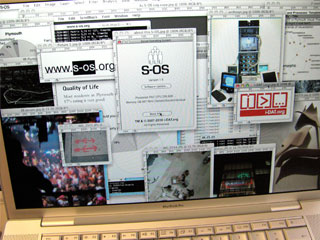
8 February – 6 April. i-DAT, in collaboration with Plymouth Arts Centre, presents: “S-OS: a Social Operating System” for the city of Plymouth. S-OS is a collection of creative interventions and strategic manifestations that provides a new and more meaningful ‘algorithm’ for modeling ‘Social Exchange’ and proposes a more effective ‘measure’ for ‘Quality of Life’. The S-OS project provides an Operating System for the social life of the City of Plymouth. It superimposes the notion of an ‘OnLine’ Social Operating System onto ‘RealLife’ human interactions, modeling, analyzing and making visible the social exchange within the City.
S-OS: Social Operating System for Plymouth.
8 February – 6 April 2007
i-DAT, in collaboration with Plymouth Arts Centre, presents: ‘S-OS: a Social Operating System’ for the city of Plymouth. S-OS is a collection of creative interventions and strategic manifestations that provides a new and more meaningful ‘algorithm’ for modelling ‘Social Exchange’ and proposes a more effective ‘measure’ for ‘Quality of Life’.
The idea of a ‘Social Operating System’ (referencing computer Operating Systems such as Mac OSX and Windows) has emerged through the prominence of OnLine Social Networking Software such as Facebook and Myspace. These websites, the software that drives them and the online communities that thrive around them form a “platform for online living where all social activities are integrated.” Wired (2007).
The S-OS project provides an Operating System for the social life of the City of Plymouth. It superimposes the notion of an ‘OnLine’ Social Operating System onto ‘RealLife’ human interactions, modeling, analyzing and making visible the social exchange within the City.
Whilst town planners and architects model the ‘physical’ City and Highways Department’s model the ‘temporal’ ebb and flow of traffic in and around the City, S-OS will model the ‘invisible’ social exchanges of the City’s inhabitants. Plymouth Arts Centre will be converted into a ‘Central Processing Unit’ to run S-OS as a RealLife Social Operating System, generating creative interventions and strategic manifestations on, by and for the citizens of Plymouth.
i-DAT, a Centre of Expertise at the University of Plymouth, is a catalyst for creative innovation across the fields of Art, Science and Technology, facilitating regional, national and international collaborations and cultural projects. As a networked organisation and ‘cultural broker’ i-DAT’s transdisciplinary agenda fosters ‘open innovation’, Knowledge exchange and reciprocal relationships between companies, institutions, communities and individuals.
Plymouth Arts Centre and i-DAT present a series of new projects and residencies that have been developed through an ongoing collaboration that explores new systems and technologies for artistic production, dissemination and participation that challenge the traditional models of creation and consumption of art.
S-OS: Informal MusicAndy Prior, Justin RobertAbout Informal Music
‘Informal Music’ records and mixes the acoustic environment of the City of Plymouth. Presenting the noises and traces of human communications in and around city, Informal Music mixes field recordings of social exchange (conversations, songs, whistles and rants).
The resulting signals provide an acoustic residue or echo of human interaction.
The processor can be modified through interaction with the S-OS: Index Application.
S-OS: RoutinesRoutines Collective About Routines
No one really knows Plymouth – and you can bet that if you asked every one of the 240,000 residents to draw a map of their city, each map would be significantly different.
Each one of us gets to know Plymouth from our own particular perspective. We construct ‘mental maps’ of the city from the routes that we take to and from familiar places, such as our favourite shops, the people that we like to visit and our place of work.
These routes become ‘routines’ and form patterns that reflect our understanding of the city. ‘Routines’ documents a few of the routes that people take during their day. This documentation consists of:
A) GPS tracks recorded over a day and are replayed in real-time.
B) Photographs of conversations or exchanges with other people that occurred at times through out the day
S-OS: Cyborgian GeographiesShaun MurrayAbout Cyborgian Geographies
Shaun Murray’s projects are harbingers for a meaningful ecological (both machinic and natural) audit of specific sites and the development of a series of tactics and protocols that can deliver to architects a full understanding of their sites and of the agents, provocateurs, cybernetic systems and disparate observers and drifters that influence and use them.
Modern architecture has failed to provide architects with these now very necessary tools to create architectures that are fully in tune with the wide gamut of artificial and natural ecological conditions. For those of us interested in the architecture for the new cyberised, biomachined inhabitants of the twenty-first century Murray’s research and propositions are a beacon in a still dark landscape of the future.
S-OS: HappiesChris SaundersAbout Happies
How happy are you? By measuring the little exchanges that take place daily you can calculate your personal ‘Happindex’. Personal Happindex’s can be collected, pooled with others and processed to measure Plymouth’s overall Happindex. The Plymouth Happindex can then be plotted to see how it performs against other more established indexes such as the FTSE, Nasdaq and Dow Jones.
To generate your Happindex you will need to either download the Happies Application to your mobile by visiting www.s-os.org or visit the S-OS exhibition at Plymouth Arts Centre and transfer it to your phone using Bluetooth. Run the application and register the exchanges that happen to you. Your personal Happindex will be calculated. Select the upload feature and it will be added to help calculate the overall Happindex for Plymouth. You can also add new ‘exchanges’ to the Happies list.
S-OS: dn[T]3 Plymouth Visual ThesaurusGianni Corino, Andrea Giacobino, Gabriele Isaia, Motor About dn[T]3 Plymouth Visual Thesaurus
Plymouth dn[T]3 or Plymouth Visual Thesaurus is an interactive video installation for public spaces like galleries, squares or mall, indoor projection and ideal for huge outdoor projections, a collective digital graffiti. This project balances art, information design, linguistic psychology and social computing. Through a very simple interaction process the project means to show emerging knowledge pattern in the way we perceive our urban and social space and come out with new vision about collective way to organise knowledge on some current local and global issues.
The project applies a folksonomies model, typical of Internet digital world to real world, but instead of describing and classifying digital goods people are asked to contribute to the creation of a meta-knowledge about real objects, everyday situations, emotions, concepts, everyday social life, etc. The aim is to build a semantic ecosystem, a memetic ecology of the city shown it’s social capital, through a collection of tags. The semantic e analyses words sent via SMS with an inferential engine – custom folksonomies engine – and tracks each word received as: absolute frequency, relations frequency.
Interaction is free, in real-time and easy, people just need to send theirs free association words (tags) via SMS and immediately they become part of the project visual thesaurus. The SMS methodology of communication has been chosen because of the special relationship we have with the mobile phone and with words through it: sometimes intimate, symbolic, or emotionally involving. The word (tag in our case) flows from small to big, from private to public, from personal to collective.
S-OS: ten’segrityDan Bater, Mike Phillips.About ten’segrity
The tenosegrity Application allows visitors to the S-OS exhibition to submit camera phone portraits to the tenosegrity database via Bluetooth. Once submitted their portrait can be interconnected within the tenosegrity collective, each connection can be weighted using a simple star rating to indicate levels of familiarity and separation.
Subsequent interaction with the application reveals the social tensions that bind a community through the dis/con-tinuous push/pull forces of tension and compression, or attraction and repulsion.
The integrity of the tensions captured within the tenosegrity application provides a numerical value of social synergy and degrees of separation. tenosegrity outputs the value of the synergetic forces within these volatile social relationships.
S-OS: IndexB Aga, Mike Phillips, Justin Roberts.About Index
The S-OS Algorithm: A(n):= [r = 1,2,…..N], where A(n) is probably the value of Social Exchange or the Quality of Life, and [r = 1,2,…..N] are the numerous calculations that happen within a city. These calculations constitute an invisible fabric woven through the everyday processes of social exchange (a smile, a swap, a sneer) and can be understood as a Social Operating System when made manifest through the use of digital technologies.
Each of the S-OS applications exhibited in the S-OS exhibition generates a value. The S-OS Index takes the various value feeds from across the exhibition space (as represented by ‘r’) and allows visitors to the exhibition to prioritise one input over the other. This last ambiguous human interaction provides the final value of A(n)! The calculation is complete.
Online Curatorial Networks. 19 January – 9 February. In residence developing a curatorial seminar. Basak Senova is an international curator and founder of the online curatorial project nomad TV. She will undertake a two-week research residency hosted by Plymouth Arts Centre and i-DAT as part of the Curatorial Network programme to explore the potential of online environment and social networking tools as mechanisms for generating cultural exchange. The particular focus of the residency is on ideas of cross-cultural generosity, sharing, communication and social interaction in contemporary curatorial practice. Using the Curatorial Network’s online resources including discussion List and website as a research platform, Senova will initiate a debate about curatorial exchanges and develop a map of curatorial network in the region and internationally. In this way she will also map parallel cases and counter-actions that are linked to contemporary art practices that set new modes and channels for social, political and cultural information flow. The Curatorial Network runs a series of international curatorial research residencies and seminars as well as international visits for curators based in South West of the UK. For further information on the Curatorial Network, details of the programme and to join the discussion list, see http://www.curatorial.net/
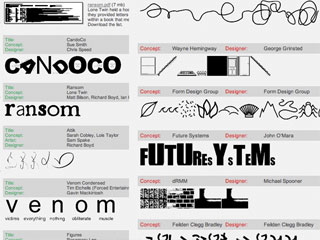
The fonts were developed by students and staff from Looe Community School, who have been assessed as being dyslexic or shows dyslexic traits. The fonts were developed as part of the dyslexier.org project by Looe Community School in conjunction with the IBeam project, created by Plymouth Arts Centre and the Institute of Digital Art and Technology. The students also developed the www.dyslexier.org website to reveal their experiences of being Dyslexic.
Further Font editions include:
IBeam Dancers Font:
Title: CandoCoConcept: Sue Smith / Designer: Chris Speed
Title: Ransom Concept: Lone Twin / Designer: Matt Bilson, Richard Boyd, Ian Hutchison
Title: Attik: Concept: Sarah Cobley, Lois Taylor / Artist: Sam Spake / Designer: Richard Boyd
(26/05/2005). IBeam – Dyslexics Edition is launched on Monday 6th June 2005 3.30pm at the bus stop opposite the Police Station in Looe town centre. Eight posters made using IBeam – Dyslexics Edition fonts are being exhibited in public spaces across Cornwall and Plymouth. Each poster features a typeface that can be read better than conventional typefaces, expresses the designer’s feelings or helps them read and type more effectively. The fonts were developed as part of the dyslexier.org project by Looe Community School in conjunction with the IBeam project, created by Plymouth Arts Centre and the Institute of Digital Art & Technology. IBeam is an ongoing research programme into creative processes using font design. www.dyslexier.org is a website made for dyslexics by dyslexics. IBeam – Dyslexics Edition was supported by Creative Partnerships, Proof Print Arts and Artytechs. http://www.i-dat.org/projects/ibeam
The Catalogue show opens at the start of National Architecture Week on June 22nd 2002 at the Plymouth Arts Centre. It features the work of seven artists, academics and architects all of whom are invited to show their work within the framework of the exhibition. The show and its educational project have been kindly supported by the Arts Council of England, i-DAT and the Plymouth Arts Centre. The concept of the show is a simple one; turn the gallery into a reference Catalogue for the public to further access pieces of work that raise questions about the nature of our relationship with interior design and architectural space.






You must be logged in to post a comment.