“Familiar Strangers”: Artist Residency Lee Nutbean

“Familiar Strangers”: Artist Residency Lee Nutbean

 
6th – 15th June 2014
Open 11am-6pm
KARST: 22 George Pl, Plymouth, PL1 3NY
http://www.karst-projects.org/
http://greaterthanone.i-dat.org/
You are invited to visit the Karst Artist Residency with Lee Nutbean in partnership with i-DAT from the 6 June – 15 June, culminating in the final presentation of his work on Sunday the 15th from 3pm – 7pm, followed by the closing party for the FAX exhibition at 7pm.

“Familiar stranger:
an individual who is recognized from regular activities, but with whom one does not interact “ (Milgram, 1972)
For this artist residency at KARST: Plymouth, interactive artist and researcher Lee Nutbean will be exploring this notion of ‘familiar strangers’ coined by Stanley Milgram in his 1972 ‘Familiar Stranger Study’. He will develop a wireless shape shifting network to elicit real time pattern and proximity data from the ‘familiar strangers’ we encounter on a daily basis. The network will facilitate adHoc opportunistic assembly and clustering by both hardware and software configurations, and provide a networked ecology to harvest, aggregate and disaggregate realtime geospatial data.
The networked ecology will act as a platform, and the correlated material will be processed to explore the use of provocative prototypes to create new meaningful sensory experiences.
Over the residency period a selected ‘provotype’ will be beta tested and refined to create a final output in the form of an electronic interactive installation. The installation will directly interact with members of the public and will create a meaningful insight into this hidden social network in which we are all embedded.
This residency is part of KARST Studio2 Residency Programme that coincides with their current exhibition ‘FAX’, which is a traveling exhibition curated by João Ribas, in collaboration with KARST and co-organised by The Drawing Center, New York, and Independent Curators International (ICI), New York.

ABOUT THE ARTIST

Lee Nutbean is an Interactive artist working at the transdisciplinary intersections of art and participation, across academia, research and the creative industries. His work explores the evolution of smart networked technologies through the participatory design of provocative prototypes, that elicit and respond to inspirational data through subversive open-ended environments. These electronic ecologys culturally probe the dynamic networks within and between corporeal and viral spaces to reveal new phenomena that confront, question and push new digital practices to innovate and inspire public engagement.
 
 
ABOUT FAX
KARST: Plymouth
15th May – 15th June 2014
Exhibition open Thurs – Sun 11-6pm
CLOSING EVENT : Sunday 15th June 5-7pm
ARTISTS:
DAVID BLANDY,  PAUL BUCK, GREIG BURGOYNE , HEMAN CHONG, FRED FOREST, JACOB DAHL JURGENSON, MARKO  MÄETAMM,  JACOPO MILIANI,   SLADJAN NEDELJKOVIC, CLUNIE REID, MARTHA ROSLER, JOSEF STRAU, RICHARD WENTWORTH
Guest Curator: João Ribas, in collaboration with KARST and co-organised by The Drawing Center, and Independent Curators International (ICI), New York.

Technology for transmitting printed images and texts dates from the nineteenth century, however it was the introduction of modern fax machines in the 1970s that turned facsimiles into a ubiquitous communications medium.  Although generally used for international business purposes, artists readily exploited its immediate, graphic, and interactive character. The fax has subsequently become it an important part of the history of art, appearing in movements such as Fluxus, and the burgeoning practices of new media artists. But with the fax machine now fast becoming a technology of the past, how do artists see the potential of the fax transmission today?
The first FAX exhibition, held at The Drawing Center in New York, 2009, featured works sent via fax by nearly 100 creative practitioners. Artists, architects, designers, scientists and filmmakers, spanning multiple generations, were invited to transmit works during the exhibition, to a working fax machine in the gallery.  FAX has since toured around the world, and every host institution has invited additional participants.  The pieces received during each showing have steadily expanded the initial core of works, and this cumulative process has created a broad collection from across the globe.
The twentieth showing of FAX takes place at KARST, and a select group of new collaborators have been invited to take part. Faxes will be received in real time in the exhibition space, throughout the duration of the show, and will include drawings and texts, as well as inevitable junk faxes and errors of transmission. The artworks, reflecting ideas such as reproduction, distribution, communication and technological obsolescence, will be permanently added to the ever-accumulating project.
 
LOGOKARST         i-DAT Logo red_Inspire

Craft and Technology Residencies 2013


http://www.watershed.co.uk/get-involved/opportunities/2012-10-22/craft-and-technology-residencies-2013/
Watershed is offering three makers’ residencies to research new projects at the intersection of craft, technology and culture. Delivered in collaboration with the Crafts Council, i-DAT, the Autonomatic research group at University College Falmouth, and supported by the Esmée Fairbairn Foundation, this is a unique opportunity to explore process and practice, develop experimental works and make new connections.
There are three residencies available, open to UK-based makers (makers can apply as individuals or groups) from all contemporary craft disciplines. The residencies will be hosted within three distinct collaborative environments in the South West of England: Pervasive Media Studio (Bristol), i-DAT (Plymouth) and Autonomatic (Falmouth). The residencies will support early stage projects that require critical, and technical, investigation and discussion.
Each resident maker/s will receive research, development and production support for their project and the residency will last for three months, beginning in January 2013, culminating in a showcase event in late March.
For more information on the programme and details on how to apply, please download the brief and application form below.
If you need any further information, don’t hesitate to get in touch with iShed Producer Victoria Tillotson on 0117 370 8872 /victoria@watershed.co.uk
[Closing Date: 9am on Mon 22 Oct 2012]
APPLICATION FORMS AND CRAFT AND TECHNOLOGY RESIDENCIES BRIEF:
Craft and Technology Residencies Brief
Craft and Technology Residencies Application Form
Image: Ghosts in the Garden © Steve Poole 2012

Le corps jouable, Marc Fournel, vidéos et installations.

Le corps jouable, Marc Fournel, vidéos et installations.

lecorps
DAGAFO and [Séquence] are pleased anounce the launch of The Playable Body, Marc Fournel, videos and installations at OBORO on March 26, 2010 from 5 to 7 pm, 2001 rue Berri, Montréal.
The Playable Body, Marc Fournel, videos and installations is a publication about the artistic work of Marc Fournel from 1995 to 2009 that comprises texts in English and French by authors Fabrice Montal, Caroline Seck Langill, Jean Gagnon, and Mike Phillips. The monograph also includes a short text by the artist about the enigmatic titles of his works. The hardcover book is illustrated with color photos.
The Gallery [Séquence] in Chicoutimi and DAGAFO have collaborated for this publication. Volumes, essays, and critical articles on works of contemporary Quebecer artists whose approach is based on new media are rare. This edition makes us discover a particular figure in the landscape of media art, while at the same time contributing to the necessary documentation of these artistic practices.
Marc Fournel, after some videographic productions between 1995 and 1998, begins to more systematically explore the application of informatics and softwares, particularly open-source softwares. Since 2004, he has devoted himself full-time to his artistic research, which has allowed him to produce a number of works, but also to develop his informatics tools and instruments. His artistic work has been presented nationally and internationally, notably at OBORO in Montreal, [Séquence] in Chicoutimi, Interacess in Toronto, at the International Festival of Video Art of Casablanca, at L’IRCAM in Paris, and at the Foundation Telefonica in Buenos Aires.
DAGAFO is a non-profit organization founded in Montreal in 2007 by Ricardo Dal Farra, Jean Gagnon, and Marc Fournel. DAGAFO supports, develops, and produces projects—by means of exhibitions and publications —that foster cultural exchange and relations on a national or international level. DAGAFO thanks [Séquence], Chicoutimi (QC) and i-DAT, Faculty of Technology, University of Plymouth (UK) for their collaboration in this publication, as well as the Canada Counsel for the Arts for its financial support.
[Séquence] is an important regional center in Saguenay for the production and presentation as well as the development of media art and new media in Quebec. The center’s implication in the development of international relations has allowed it to put in place a strong network of exchange, presentation, and production of media art works. [Séquence] would like to thank: DAFAGO, the Conseil des arts et des lettres du Québec, the Conseil des Arts de Saguenay, and the city of Saguenay.
Available after book launch through the website of RCAAQ: http://rcaaq.org/librairie/

Ellie Harrison at Plymouth College of Art

Ellie Harrison at Plymouth College of Art

Plymouth College of Art

Ellie Harrison
www.ellieharrison.com

A rundown but functional old vending machine stands alone in the Viewpoint Gallery at Plymouth College of Art. Every now and again, without warning, it springs into life – spewing out free packets of crisps for gallery visitors. The machine, you see, has been modified. It no longer functions in the conventional way – at the whim of snack-hungry students – but instead now finds itself in the control of outside forces… Its new nervous system is a networked computer. Hidden out of view and running special software, it continually scans the news on the BBC RSS feed – commanding the machine only to release snacks when words relating to the recession make the headlines.

Whilst seemingly an act of generosity – gifting free food at moments when further doom and gloom is reported – the Vending Machine also hints towards a time in the future when our access to food may literally be determined by wider political or environmental events. We may not be able to access what we want, when we want, at the touch of a button. This dystopian vision is toyed with in an accompanying piece in collaboration with i-DAT . For the first two weeks of the exhibition at the Viewpoint Gallery, the GreenScreen on the front of the Portland Square Building at the University of Plymouth will be used to make public-service-style announcements at the exact moments when the Vending Machine releases food. The words ‘FREE FOOD’ will appear, emblazoned in metre-high letters on the side of the building encouraging passersby to run to the gallery and claim their supplies.

The Vending Machine project is one of the outcomes of Ellie’s period of residency at Plymouth College of Art in 2009 and is on show at the college Viewpoint Gallery as part of her solo exhibition from 23rd April – 30th May 2009. It was programmed by Ben Dembroski in PureData and Python and uses project2891 to communicate with i-DAT in order to activate the messages on the GreenScreen. Production assistance by Jason Mills.
http://www.ellieharrison.com/index.php?pagecolor=3&pageId=project-vendingmachine

Exhibition Opening:
5.00pm – 7.30pm
Wed 22nd April

Open to the public:
Thurs 23rd April Sat 30th May


Marc Fournel Canada Council for the Arts Grant – New Media Residencies:

Marc Fournel Canada Council for the Arts Grant – New Media Residencies:

Marc Fournel
i-DAT has been awarded a Canada Council for the Arts ‘Grants to New Media and Audio Artists: New Media Residencies’ for the sound and installation artist Marc Fournel. This follows initial funding from the Canada Council for the Arts for a research visit to i-DAT in September 2007, where Marc presented a first version of his installation SKIN-PÔ. This new award will enable Marc to develop a project incorporating Arch-OS and the Immersive Vision Theatre (Full Dome). Watch this space for further developments:

Plymouth Arts Centre & i-DAT Collaboration.

Plymouth Arts Centre & i-DAT Collaboration.

A new series of projects and residencies that have been developed through an ongoing collaboration exploring new systems and technologies for artistic production, dissemination and participation that challenge traditional models of creation and consumption of art. Artists and Curator; Stanza (UK) 8 February – 6 April, Cadu (Brazil) 11 January – 11 March and Basak Senova (Turkey) 19 January – 9 February, will be residence spending time at both organisations exploring new work to create a series of new commissions and a seminar. i-DAT refer to the prominence of online social networks to create a series of creative interventions and works S-OS: Social Operating System for Plymouth in the galleries at Plymouth Arts Centre from the 8 February – 6 April.
http://www.plymouthac.org.uk

Basak Senova.

Basak Senova.

Basak Senova is an international curator and founder of the online curatorial project nomad TV. She will undertake a two-week research residency hosted by Plymouth Arts Centre and i-DAT as part of the Curatorial Network programme to explore the potential of online environment and social networking tools as mechanisms for generating cultural exchange.
The particular focus of the residency is on ideas of cross-cultural generosity, sharing, communication and social interaction in contemporary curatorial practice. Using the Curatorial Network’s online resources including discussion List and website as a research platform, Senova will initiate a debate about curatorial exchanges and develop a map of curatorial network in the region and internationally. In this way she will also map parallel cases and counter-actions that are linked to contemporary art practices that set new modes and channels for social, political and cultural information flow.
The debate generated through the residency will conclude with development of a seminar for March 2008, as the third of the Curatorial Network programme. The Curatorial Network is a collaborative initiative involving curators working independently and as part of organizations across the visual and applied arts, museum and academic sectors. It offers an online portal and programme of activities dedicated to the development of curatorial practice through critical debate, collaborations, professional development opportunities and exchange. It explores the metaphor of ‘network’ in relation to curating to discuss dynamics and models of curatorial networks, to advance collaborative curatorial practice and to develop international curatorial network. The Curatorial Network runs a series of international curatorial research residencies and seminars as well as international visits for curators based in South West of the UK. For further information on the Curatorial Network, details of the programme and to join the discussion list, see http://www.curatorial.net/

Cadu.

Cadu.

11 January – 11 March.
Cadu (Carlos Eduardo Felix da Costa) has been invited to undertake a three-month residency as part of an International Fellowship supported by the Arts Council of England. Cadu is an artist based in Brazil and will undertake this residency for the first time in the UK. This is an opportunity for this artist to define new ideas and processes in his work, by collaborating quite specifically with i-DAT the artist intends to work with the Robotics Research department at Plymouth University. This situation is a unique opportunity for the artists to explore advanced technologies and collaborate with engineers and scientist.
The International Fellowships Programme enables artists from all art forms and at any stage of their career to engage with artists and arts organisations from other cultures and disciplines. Selected artists are offered fellowships primarily for practice-based research, experimentation and the development of new work in relation to the artistic ethos of international hosts and the cultural contexts of the countries in which they are based.

i-DAT/Submerge Interactive Architecture Residency.

i-DAT/Submerge Interactive Architecture Residency.

i-500news.jpg
Dr Paul Thomas, Artistic Director of BEAP.(Biennale of Electronic Arts Perth 2007) will be the i-DAT Interactive Architecture Resident artist during the month of July. Thomas will be further developing Arch-OS through the i-500 Project extension. With funding provided by Curtin University the residency will focus on the articulation of the dynamic data generated by the public art instillation to be incorporated into the fabric of the Curtin University of Technology Minerals and Chemistry Research and Education Precinct buildings. http://www.i-500.org

Making a Difference at the University of Plymouth

Making a Difference at the University of Plymouth

11-22/10/2004:

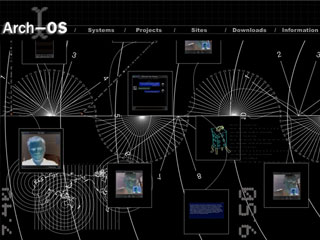
Please join us with the Vice-Chancellor of the University for a breakfast preview at 10am, on Monday 11th October 2004. Making a Difference at the University of Plymouth is a project for i-DAT by Lucy Kimbell. It uses Arch-OS, an innovative digital system embedded in the architecture of the Portland Square building, enabling passers-by to express the corporate mantra of our times. On pressing a special button, the phrase is broadcast over the entire building, beginning with the first clear iteration of sound but increasingly becoming layered and invasive. The wish to make a difference is also automatically sent as an email to the Vice-Chancellor of the University to register this fact. Data is collected and made public but to questionable effect.

Higher education has changed rapidly over recent years, reflecting the general tendency of increased corporatisation of culture at large. Management cultures insist on personal responsibility where the individual employee is supposed to align themselves with the organisation’s brand values. The phrase, ‘I want to make a difference’, reveals something of the tendency towards increased individualisation and a break with previous collective ways of engendering change. Does this demonstrate the view that large corporate and hierarchical institutions are ineffectual, that local and more complex models are at work in the forces of change? Who holds responsibility in seeking positive improvement in the workplace and in terms of the service on offer? Will the number of people pressing the ‘I want to make a difference’ button reveal a true willingness or an empty gesture towards change? The shift from the individual sound to a chorus by the end of the project presents itself as an allegory in this respect.

Lucy Kimbell is AHRB Creative and Performing Arts Fellow at the Ruskin School of Drawing and Fine Art, University of Oxford.

Making a Difference at the University of Plymouth is a project by Lucy Kimbell, with special thanks to George Grinsted for software development.

Original HTML website can be found here: https://i-dat.org/wp-content/blogs.dir/oldi-DATprojects/makingadifference/index.html

Arch-OS was decommissioned in 2017 and although the infrastructure still exists (including the 3D speaker system and audio servers) the Arch-OS core server is no longer functioning.