International Artist Fellowship: Cadu:

International Artist Fellowship: Cadu:


11 January, 11 March. Cadu (Carlos Eduardo Felix da Costa) has been invited to undertake a three-month residency as part of an International Fellowship supported by the Arts Council England. Cadu is an artist based in Brazil and will undertake this residency for the first time in the UK. This is an opportunity for this artist to define new ideas and processes in his work, by collaborating quite specifically with i-DAT the artist intends to work with the Robotics Research department at the University of Plymouth. This situation is a unique opportunity for the artists to explore advanced technologies and collaborate with engineers and scientist. The International Fellowships Programme enables artists from all art forms and at any stage of their career to engage with artists and arts organisations from other cultures and disciplines. Selected artists are offered fellowships primarily for practice-based research, experimentation and the development of new work in relation to the artistic ethos of international hosts and the cultural contexts of the countries in which they are based.

Station to Station

Station to Station

station2sation
The Station to Station website launches on the 25 February 2008
This project is part of the centenary celebrations of the Bere Alston – Gunnislake railway and the first train over its spectacular highlight, the Calstock Viaduct which links Devon & Cornwall across the Tamar.
This centenary will be celebrated with a weekend packed full of events on the Tamar Valley Line trains and on the Plymouth, Beer Alston, Calstock & Gunnislake stations on the 23 February – 3 March 2008.
Station to Station is developed through a partnership between Bere Ferrers and Calstock Parish Councils, Devon and Cornwall Rail Partnership, Tamar Valley AONB, University of Plymouth, i-DAT, and West Devon Borough Council.

Dome Fugue v1.0:

Dome Fugue v1.0:

fugue.jpg
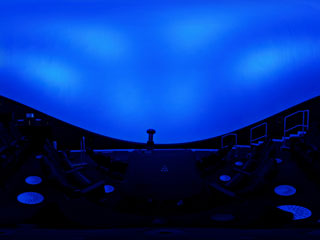
1.30: Sunday 24 February 2008. The Immersive Vision Theatre and i-DAT present the ‘Dome Fugue v1.0’. This is a specially commissioned sonic experience to celebrate the re-birth of the William Day Planetarium as a transdisciplinary instrument for the manifestation of material, immaterial and imaginary worlds. This pre-launch rendering of the ‘Dome Fugue v1.0’ will be performed in the Full Dome using its cutting edge spatialised sound system and accompanied by immersive generative visualisations. ‘Dome Fugue v1.0’ has been composited by i-DAT, researchers in the Nascent Art & Technology Research Group and The Immersive Vision Theatre ‘Domies’. The piece lasts 23 minutes 56.0409053 seconds, a scaled down sidereal period (a single rotation of the Earth relative to the stars). The Dome has seating for 35 people. The newly developed Immersive Vision Theatre was brought to life by the Experiential Learning CETL (Centre for Excellence in Teaching and Learning) under the direction of Dr Ruth Weaver. The future management of the Dome lies with the Centre for Creative Design and Technology, a cross faculty (Arts & Technology) initiative and a transdisciplinary catalyst for innovation to influence the evolution of new creative design practices and strategies.

Dome Fugue v1.0 is part of Voices III the Peninsula Arts Contemporary Music Festival 2008. Friday 22 – Sunday 24 February 2008. http://cmr.soc.plymouth.ac.uk/event.htm

SwanQuake

SwanQuake

SwanQuake
The SwanQuake User Manual is published by Liquid Press/ i-DAT for igloo (http://www.igloo.org.uk/): ISBN Number: 978-1-84102-172-0 .
SwanQuake is a surreal semi-abstract inhabited world, home to a series of potential encounters. These may be theatrical and dreamlike, sometimes uncanny perhaps even frightening, at times quotidian and familiar. It’s these interactions that inspire curiosity, wonder and the desire to continue looking and sensing. However, despite the title ‘mashup’ of computer game Quake and traditional ballet Swan Lake, there are no targets, health points, wins or dying swans here…
More information on the SwanQuake website: www.SwanQuake.com

"Have Dome Will Travel"

"Have Dome Will Travel"

cluny2.jpg

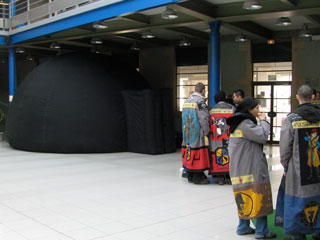
18/12/07: Pete Carss (i-DAT PhD & chief Dome RA), Professor Neil James (Dean of the Faculty of Technology) & Mike Phillips (i-DAT) magically transport a 5 meter inflatable Go-Dome and peripherals all the way to Cluny in Saone-et-Loire, France. The team presented a dome corrected 3D model of the Cluny Abby at the Ecole Nationale Supérieure d’Arts et Métiers, Centre de Enseignement et de Recherche de Cluny. The 3D model, developed by Christian Pare and his team for high resolution stereoscopic, immersive and interactive viewing, was supplied for experimentation within dome environments. The team latter visited the Institut Image in Chalon sur Saone as guests of Christian Pare for a tour of their cutting edge Cave and force feedback systems.

Arch-OS at the Opera

Arch-OS at the Opera

royaloperalogo.jpg
21/11/2007: Arch-OS demonstrated its ecological applications at the Royal Opera House ‘Recycle Our House’ Green Awareness Day. As part of its concerted efforts to be a world class ‘green’ organisation Chris Speed and Mike Phillips, at the invitation of Hywel David, to talk about Arch-OS as a possible tool for achieving its ambitions. Arch-OS presented twice during the day along side Tony Hall, the Executive Director of the Royal Opera House, Perry Walker, Head of Democracy and Participation at nef (New Economic Foundation), Donnachadh McCarthy, Cycle Solutions and an Energy Bike. (image: section of the Recycle Our House logo designed by Darcey Bussell).

Noogy 2.0

Noogy 2.0

noogy2.jpg
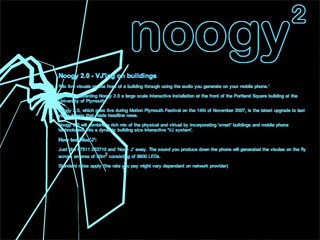
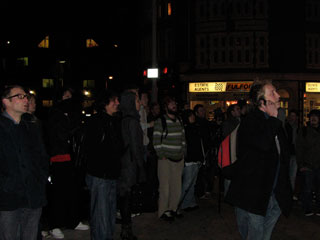
– VJ’ing on buildings. (14/11/2007) Mix live visuals on the front of a building through using the audio you generate on your mobile phone. i-DAT is presenting Noogy 2.0 a large scale interactive installation at the front of the Portland Square building at the University of Plymouth. Noogy 2.0, which goes live during Motion Plymouth Festival on the 14th of November 2007, is the latest upgrade to last years Noogy that made headline news. Noogy 2.0 will combine a rich mix of the physical and virtual by incorporating ‘smart’ buildings and mobile phone technologies into a dynamic building size interactive VJ system. How too ‘Noo – J’: Just dial 07511 253710 and Noo – J away. The sound you produce down the phone will generate the visuals on the fly across an area of 50m2 consisting of 9600 LEDs. Standard rates apply (the rate you pay might vary dependent on network provider)http://www.noogy.org/ (rather poor phone movie..) http://www.youtube.com/watch?v=dqWS9m0osh0

Processing Workshop/GreenScreen

Processing Workshop/GreenScreen

greenscreenlaunch.jpg
(05/11/2007). Ruairi Glynn b-DAT graduate and developer of interactive architectures (see interactivearchitecture.org) delivered a 3 day Processing workshop in processing. A-Tec researchers and students worked with Arch-OS data feeds to develop dynamic imagery for the Green Screen installation in Portland Square.
Part 1: http://www.youtube.com/watch?v=W388aBDmo2o
Part 2: http://www.youtube.com/watch?v=viY8dGx_mAI

Green Screen Installation

Green Screen Installation

greenscreen.jpg
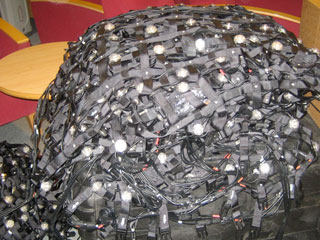
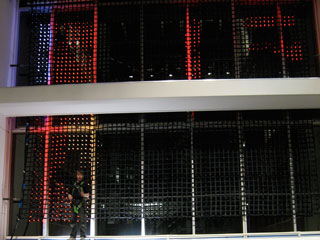
Built to communicate the Centre for Sustainable Futures (CSF) CETL (Centre for Excellence in Teaching and Learning) agenda and sustainable information about life at the University of Plymouth the ‘Green Screen’ has been installed.
This large scale LED matrix fill the top 3 floors of the windows of Atrium A of Portland Square. This full colour screen will display information and graphics that describe ecological and social data collated from a day in the life of the University campus.
Waterfalls of water will be seen cascading down the building changing in size according to how many taps were turned on and how many toilets were flushed in a day. Fire will leap up the building describing how much energy was used to heat buildings, and forests of trees will be seen to fall depending upon how much paper was used. The system will be publicly interactive through mobile phones and will be able to show a wide variety of movies, messages and graphics that the North Hill pedestrian and road traffic will be able to see.
The technology behind the screen is relatively low on energy consumption considering the nature of its affect. Consisting of 9600 LED’s over a 50m2 area the screen will draw 1Kw of power, which is comparable to less than 3 PC’s being on for a working day.
The management and development of the research project is carried by the Institute of Digital Art & Technology (i-DAT) with technical consultancy provided by Pyramid. i-DAT who will maintain the systems, are working closely with the CSF to design user friendly interfaces to allow staff and students to broadcast material.
Taking digital feeds from the campus building management systems that record live data about environmental, social and network activity, i-DAT are working with creatives to develop powerful and expressive media forms that engage and involve anyone passing by the screen. Operating from 4pm to 10pm the LED systems are low energy, flexible displays that have yet to be used on this scale anywhere in the world.

Digital Media Developer: Research vacancy

Digital Media Developer: Research vacancy

graphicsjob.jpg
REF: A0228. (03/06/2007) Salary £20437 to £23692 pa, Grade 5. Plymouth. A Research Assistant is required to work for a period of six months within i-DAT to develop software to support the display of information and graphics to interpretation screens across the campus and over the internet. The post involves a close relationship with The Centre for Sustainable Futures and will require the development of media platforms to support aspects of the Centre’s delivery of information and knowledge to a wide audience. Applications are invited from people with a good Honours degree in a computing subject, who have some industrial experience in the development of serverside and networked technologies. For an informal discussion, please contact Chris Speed on 01752 232613 or email chris.speed@plymouth.ac.uk. Interviews will be held on Wednesday 11 July 2007. CLOSING DATE: 12 NOON, WEDNESDAY, 15 JUNE 2007. http://www.plymouth.ac.uk/pages/view.asp?page=19178