Explorations in immersive vision take us round in (international) circles

Explorations in immersive vision take us round in (international) circles

A futuristic festival that i-DAT helped to found, takes place at the National Space Centre this autumn.
Fulldome UK 2014 takes place on November 7 & 8 and offers 2 days of inspirational screenings, live VJ performances, radical debates and forward-thinking visions in sound and image.
The event takes place at the National Space Centre in Leicester and is open to the public. Tickets are available online here: www.fulldome.org.uk/tickets
Visitors can expect to see ‘fulldome art’ – an emergent artform using immersive environments and digital technologies to push the boundaries of artistic practice. International and UK fulldome film-makers, audio researchers and programmers will display their works at the event.
Fulldome works can be linear and non-linear, produced or generative, interactive and performative experiences projected onto the ‘full’ domed surface traditionally found in planetaria.
This makes for a highly immersive audience experience, challenging established models of cinema and gallery spaces.
Fulldome UK 2014 will host work by the following, and many more:

The festival – co-founded by i-DAT – is in its 4th year, and is run by a not-for-profit association that supports artists and researchers working within fulldome immersive environments including i-DAT’s Professor Mike Phillips, GaiaNovaThe Computer Arts Society (CAS) and the National Space Centre (NSC) through NSC Creative.
“We’re defining the emergent artform of fulldome art with collaborations with the world’s leading performers, projection mapping experts and VJs. It’s super-cool”, said Mike.
i-DAT is awaiting news on Arts Council England funding for staging Fulldome UK 2014 in Leicester.
Previous festival action happened in August at Kendal Calling. Fulldome UK curated a cross-section of some of its best immersive audio-visual short fulldome films to support a playback of the ground breaking fulldome album The Search Engine by Ninja Tunes artist DJ Food – making its UK music festival premier. There were also lectures that flew festival-goers through the Universe and beyond the stars!
Back in June and July i-DAT hosted a week-long E/M/D/L fulldome prototyping workshop in Plymouth, inviting international participants to experiment with the platform.
The artistic research that took place during the workshop was in the areas of projection mapping, performance and interactivity “contributing to a redefinition of fulldome art,” said Mike Phillips.
i-DAT is the UK partner of E/M/D/L – The European Mobile Dome Lab for Artistic Research – an international collaboration awarded €400k by the EU Culture Programme.
E/M/D/L is a network for the exchange of artistic and technological expertise within the full-dome medium. The partnership connects four European and three Canadian institutions and cultural partners, all leaders in this field, sharing and expanding skills, methodologies, strategies and content.
The project began in February this year and by September 2015, there will have been eight residencies and public presentations in five countries, using a mobile domic architectural structure equipped with cutting-edge technologies.
E/M/D/L will climax with a series of performances at the world’s most sophisticated virtual theatre, the Satosphere in Montreal, Canada.
Partners in E/M/D/L include i-DAT, the University of Applied Arts in Vienna, Austria, the Trans-Media Academy Hellerau/CYNETART Festival in Dresden, Germany, the National and Kapodistrian University of Athens in Greece, the Society for Arts and Technology and kondition pluriel in Montréal, Canada, and LANTISS (Laboratoire des Nouvelles Technologies de l’Image, du Son et de la Scène)/Université Laval, Quebec City, Canada.

i-DAT & IBM thinking smarter together

i-DAT & IBM thinking smarter together

One of the biggest names in the digital realm was the guest of i-DAT and Plymouth University earlier this month for the Smarter Planet Lab event.
The event was open to Plymouth University staff, students, researchers and IBM staff with an interest in the Smart Agenda / Internet of Things.
The conference stimulated discussion and an exchange of ideas around specific themes including: art and audience, culture and heritage, digital cities / digital civic, environment and sustainability.

At the conference, IBM backed i-DAT’s research ethic. Said i-DAT Creative Director Birgitte Aga: “IBM backed up our approach. We’re about research and prototyping. We’re not about development – that’s for others to do. That’s what allows us to be at the frontier and to keep experimenting”.

We hosted the developers of the future

We hosted the developers of the future

In August we hosted the search for the country’s best young coders, overseeing Young Rewired State’s Festival of Code.
A thousand young people stayed, slept and hacked in Plymouth University’s Roland Levinsky Building for the 48-hour code-fest, which climaxed in a code showcase judged by leading technical minds.
“We had some awesome judges and a thousand kids,” said i-DAT’s Creative Director Birgitte Aga. “The work they did and the quality of what they pitched was exceptional”.
Teams of young coders from all over the country worked on apps in the following categories: a brilliant idea that should exist; best example of coding; community-minded apps for coding a better country; best design and best in show. The event came to a climax in Plymouth Pavilions.
Best in Show was an app called YouDraw – a crowd-sourced video animation platform allowing anybody (creator or otherwise) to submit a video for animating by the community. Anyone who wishes will be given a random frame to draw and over time, a video will gain more and more drawn-over frames resulting in a completed YouDraw project: a fresh, new, hand-crafted animation based on any fan-favourite music video.
Best Design winner was Tourify, which creates a custom guidebook just for the user – the perfect app for travellers.
Best Use of Code winner was Let’s Combine, an app for the web, iOS, Android and Androidwear which allows the user to choose a specific location and then see different datasets available at that location, combined to show interesting or funny results.
Code a Better Country winner was an app called CityRadar for users to photograph and report problems to the correct council.
Winner of the Should Exist category was Miles Per Pound which calculates how far your car can travel with a single pound, just by entering your car’s number plate.
Judges and guests at the event included Israeli musician Yoni Bloch, famed for his interactive music video work, Kerensa Jennings, the BBC’s Head of Strategic Delivery and award-winning programme-maker, broadcaster and communications consultant Tetteh Kofi, Australian entrepreneur, venture capital investor, diplomat, author and speaker Bill Liao, Katrina Roberts, acting Vice President, GNICS Technologies at American Express, and Sathya Smith, head of partner solutions at Google.
Special guest was political wordsmith George The Poet, one of the hottest names in spoken word.
In the run-up to the final weekend, i-DAT hosted a coding centre where young people worked with data and mentors to research ideas with social impact. Other coding centres were hosted throughout the UK, but i-DAT hosted the first international coding conference with young people aged from seven to 18 from the US, Germany and the UK.
Computacenter with Plymouth University arranged robust internet connections that allowed for heavy bandwidth usage throughout the event with no downtime – another first in the event’s history.
“i-DAT and Plymouth University proved that we can be the coding centre for the app developers of the future,” said i-DAT’s Operations Director Dawn Melville.
 

How we’re measuring audience sentiment for a new app

How we’re measuring audience sentiment for a new app

ARTORY: http://www.artory.co.uk/

We’re measuring the mood of arts audiences in a ground-breaking piece of technology to be launched later this year that has really got the feel-good factor.

Earlier this summer, the Qualia system we helped to develop powered the official app for the Flux Festival in Liverpool. Now we’re working on an iteration that will benefit our city (although we can’t reveal too many details just yet).

We’re working in partnership on a project that will measure the feelings of audiences who’ve witnessed art and culture events.
The pilot mobile phone app also includes an incentive engine that encourages audience members to leave feedback, benefiting arts organisations with real-time analytics and mood-accurate feedback, whilst audience members receive points towards offers in participating venues.
Common arts evaluation techniques suffer by being disconnected and after the event, relying on enthusiastic audience members who usually have to fill in a post-show form.

Our system ‘captures the rapture’.

Qualia harvests dynamic data through a live dialogue with audience members, proposes a more meaningful qualitative evaluation, capturing the emotional experience of the arts and visually displaying how audiences are feeling.
Arts organisations will be able to see how their audiences are feeling and discover how they are engaging with the piece or the exhibition in real-time.
We think that by measuring audience moods and sentiment, we get a more accurate response – and that the results of our emotional evaluation could influence arts creation, programming, curation and funding in the future.

Like most i-DAT technologies, the Qualia system (developed in tandem with Cheltenham Festivals and the University of Warwick) is open source, allowing organisations to freely install and modify the code under the GNU GPL license. Qualia has been made available to the cultural sector through the GitHub hosting service and will be continued to developed and tailored in response to the community’s needs. It was first launched at the Cheltenham Science Festival.

Said i-DAT’s Creative Director Birgitte Aga: “This is only the beginning of manifesting and sharing emotional experience of audiences through the cloud, not only with funders, producers and curators, but also with audiences, in a real-time evolving dialogue.”

Birgitte says asking the audience might provide information that could be tough to hear for artists and organisations. “Can we, producers and curators of the arts, deal with the level of reality this reveals? Can we warmly embrace the emotions of the crowds which will lie somewhere in the cloud?”

Social Operating System:

Social Operating System:

8 February – 6 April. i-DAT, in collaboration with Plymouth Arts Centre, presents: ‘S-OS: a Social Operating System’ for the city of Plymouth. S-OS is a collection of creative interventions and strategic manifestations that provides a new and more meaningful ‘algorithm’ for modeling ‘Social Exchange’ and proposes a more effective ‘measure’ for ‘Quality of Life’. The S-OS project provides an Operating System for the social life of the City of Plymouth. It superimposes the notion of an ‘OnLine’ Social Operating System onto ‘RealLife’ human interactions, modeling, analyzing and making visible the social exchange within the City.

S-OS (http://s-os.i-dat.org/projects/s-os-v1/)

2007 : Sonic Arts Network and i-DAT present: Expo Plymouth

2007 : Sonic Arts Network and i-DAT present: Expo Plymouth

Sonic Arts Network and i-DAT present Expo Plymouth 2007.

Expo is the hub and playground of the experimental music and sound art scene in the UK and beyond and the largest free festival of its kind in Britain. Each Year the festival travels to a different town.

In June 2007 the Sonic Arts Network came together with i-DAT and creative partnerships to produce Expo Plymouth. The event, packed with installations, happenings, workshops and gigs permeated venues throughout the city for four days. This film documents some of the highlights from the weekend.

The Expo festival is a free and fun annual event. It is the hub and playground of the experimental music and sound art scene in the UK and beyond. Like a sonic circus the festival travels across the UK and this year we make landfall in Plymouth. Join us for a packed weekend of installations, sonic ferry tours, performances, exhibitions, film-screenings, happenings, a large-scale sonic picnic, workshops and gigs. Expo presents something for everyone at sites all across Plymouth. You’ll hear new and amazing things, enjoy places and spaces in new ways and be part of a truly unique event.

[Most of this material is recovered from the Expo2007 DVD]

Images from Sonic Arts Network:

Expo Venues:

Cooperage:


The White Rabbit:

The Hub:

Royal William Yard:

Lido:

And various sites around Plymouth…


Sonic Arts Networks: https://en.wikipedia.org/wiki/Sonic_Arts_Network

Expo 2007 Plymouth DVD


Tracks from the Expo 2007 Plymouth DVD

Track 1:

Evan Parker & Behaviour (extract) 8’08”

Track 2:

Vatican X-Ray Department Corporate Blond Fluffer 5’06”

Track 3:

Portable (extract) 5’23”

Track 4:

Sileni (extract) 7’18”

Track 5:

Tom Bugs & Hilary Jeffery: Tromboscillator (extract) 4’41”

Expo Youth @ Expo Plymouth 2007

2007 introduced a new stream of Expo programming where in a diverse range of Plymouth’s young people muscled in on the 2007 Plymouth Expo programme. Supported by Creative Partnerships their work added a virulent avant-local twist to out proceedings. Their work was presented at the main festival sites alongside the work of professional artists.

Expo Youth work commissioned for Expo Plymouth featured:

School of Fish: Ebait – am interactive multimedia installation featuring sub-bass reactive animated fish

5X: Digital Hotdogs – a roving hotdog cart with a twist!

The Sunmaids: Operation Raisins – Conceptual art inspired teens presented an interactive sound sculpture that dispensed both healthy foodsnacks and Casio-raisincore.

Fudge: Sweet Dreams – An interactive sound environment of space hoppers and giant inflatables

Darwin’s Walk – A large kinetic metal sculpture incorporating Soundbeam technology

[MIA Awards Winner]

In 2008, Expo will be in Brighton from 4-6 July.


Everything is Not Everything.

Everything is Not Everything.

everything.jpg
Everything is Not Everything – the stage two event for artists enrolled in the b-DAT ( digital art and technology ) course at the university of Plymouth took place across the campus on Thursday, 08 March 2007. Work and installations offered an alternative interpretation of the campus through the use of locative media and mobile phone technology. http://www.everythingisnoteverything.co.uk

Noogy in residence – part of the Motion Plymouth Festival 2006

Noogy in residence – part of the Motion Plymouth Festival 2006

noogy.jpg
(17/11/2006). Noogy: 16 – 19 November 2006. Portland Square, University of Plymouth. To talk to Noogy text: noogy; and your question.. to 07766404142. Noogy in residence is part of the Motion Plymouth Festival 2006. Noogy’s background is a little unclear. Some claim that Noogy arrived from deep space, originating somewhere off the shoulder of Orion, watching C-beams glitter in the dark near the Tannhauser gate. Others claim that Noogy grew from within the network of CAT6 Ethernet cables, silicon chips and data mines that form the core of the Arch-OS system in Portland Square. Whilst others still claim that Noogy was there all the time, waiting in the void for the digital interface that would allow his manifestation. Some say Noogy is the ‘building’, others that Noogy is just a viral infection, like a bad cold that cant be shaken.

OUTREACH CURATOR FOR i-DAT.

OUTREACH CURATOR FOR i-DAT.

outreachnews
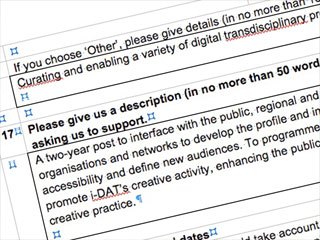
(20/07/2005). Ref: 6286/TECH. Salary £18777 to £24450, RF Scale. Closing Date: 12 Noon Friday 29 July 2005. Tel: 01752 232168 Email: jobs@plymouth.ac.uk. i-DAT (Institute of Digital Art & Technology) is dedicated to exploring innovative applications of digital technology. We are looking for a dynamic addition to our team. This two-year post, is funded by the Arts Council England, Plymouth City Council and Aimhigher. The Outreach Curator is required to increase accessibility and define new audiences, in partnership with regional and international art/science organisations and networks, to develop the profile and impact of i-DAT. A key part of the role is to create activity to enhance i-DAT’s work with a range of communities in Plymouth. http://www.Plymouth.ac.uk/vacancies