KeJi at Cheltenham Science Festival

KeJi at Cheltenham Science Festival

KeJi at Cheltenham Science Festival
Meet and talk to KeJi at Cheltenham Science Festival, 15 – 17 June

KeJi’s background is a little unclear. Some believe KeJi fell from the Asteroid 2012 EG5 on April 1st as the hunk of space rock, the size of a passenger jet, hurtled past Earth – so close it flew UNDER the moon. Others claim KeJi is the result of experimentation with artificial intelligence in a secret Chinese laboratory during the ‘The China Brain Project’.

What we do know is that KeJi is an artificial intelligent creature who communicates through tweets and SMS txts. KeJi maintains a symbiotic relationship with humans by synchronizing its heart with the average heart beat of the people it interacts with. KeJi has a big heart and gets lonely and upset when it has nobody to talk to. Why don’t you talk to KeJI!

KeJi will be present during Cheltenham Science Festival: 15 – 17 June 2012. To talk to KeJi SMS ‘talkkeji‘ and ‘your question‘ to 07766404142 or send a tweet to ‘@talkkeji‘. You can also visit KeJi in the festival space, or play the game KeJi has made for you. If you like, you could have a chat to him now, here on KeJi’s website. Just go to the ‘Talk KeJi’ page and start chatting.

ABOUT

‘KeJi’ (meaning ‘science and technology’ in Mandarin) is a collaborative commission by Cheltenham Science Festival and i-DAT, Plymouth University, of the artist and designer Nathan Gale. Nathan is working with i-DAT’s development team to create a new interactive installation and game at Cheltenham Science Festival 2012. The playful installation will be based around an artificial intelligent (AI) creature that festival visitors can ‘speak’ to through tweets and sms txts. The installation will be linked to the ‘KeJi Bounce’ game, which will be recording players’ heart rate.

KeJi’s AI is based on A.L.I.C.E. (Artificial Linguistic Internet Computer Entity), also referred to as Alicebot, or simply Alice, which is a natural language processing chatterbot — ‘a program that engages in a conversation with a human by applying some heuristical pattern matching rules to the human’s input’. It was inspired by Joseph Weizenbaum’s classical ELIZA program and developed by Richard Wallace in 1995. (Wikipedia, 2012)

KeJI function as an experiential ‘audience evaluation tool’ that gathers opinions, feelings and thoughts from visitors. KeJi also creates a subtle awareness of visitors’ individual heart rates.

There are two strands to the project, ‘KeJi Bounce’ and ‘KeJi Installation’.

KeJi Bounce

KeJi Bounce is a game that births a unique KeJi spawn character whose behaviour is linked to the ECG of the player’s heart rate and personal data. Players have to bounce on a trampoline to keep their creature afloat. The game will get increasingly harder as the user’s heart rate increases.

Users who have played the KeJi Bounce game can drop off their personal KeJI spawn character at the KeJi installation screen. The KeJi spawns will cluster to others with similar heart rates and generally bounce around with the bigger KeJi ‘the original’. Each spawn will display a name and the heart rate of its ‘owner/creator’.

KeJI Installation

The KeJi Installation is a human size CSF festival ‘Tamagotchy’ with artificial intelligence. It communicates with visitors through sms txts and tweets, as well as online through the www.keji.co.uk website.

KeJi’s ‘form’ (the number of lines/polygons) will be affected by the average heart rate of the festival visitors (fed virtually from the KeJi Bounce game) and its gradient colour and facial expressions will indicate its mood (red = angry/stressed to yellow=happy, blue-chilled and green = lonely). KeJi’s mood will also affect its response in communicating with visitors through tweets and sms txts.

Keji Fact Sheet

To find out more about Cheltenham Science Festival, please go to:
http://www.cheltenhamfestivals.com/science

Plymouth University at the Cheltenham Science Festival: http://www.plymouth.ac.uk/pages/dynamic.asp?page=events&eventID=6929&showEvent=1

Image: Vince Cable meets Keji.

PROJECT PARTNERS

KeJi is a collaborative commission by Cheltenham Science Festival and i-DAT, Plymouth University, of the artist and designer Nathan Gale. The project is made possible through sponsorship from leading audio visual solutions providers, Pyramid.

Nathan Gale – www.intercitystudio.com

Nathan Gale was art director of leading communication arts journal, Creative Review, for almost ten years. In that time he worked with some of the best creative minds in the industry – from designer Peter Saville, to advertising agency Mother. He has been on the judging panels of numerous awards, including D&AD, and has lectured at various institutions around the country. He has also written for, or been interviewed about his work by, publications such as étapes and FairyTale magazine.

Over the years, Gale’s work has been recognised and awarded by his peers. His work can be found in select D&AD annuals, was nominated as one of the Design Museum’s Designs of the Year awards, and was awarded a Silver at the Art Directors’ Club awards in New York. Gale currently works under the name of Intercity. With a network of collaborators from the worlds of art, design, photography, illustration, digital media and beyond, Intercity applies a highly creative and considered approach across a range of areas including fashion, music, publishing, branding and advertising. In addition to producing high-end graphic design, Gale also specialises in live art projects and exhibition curation.

Cheltenham Science Festival – www.cheltenhamfestivals.com/science

This summer on 12–17 June, over 300 of the world’s greatest thinkers, comedians, writers and scientists will come together to celebrate and explore all things scientific for The Times Cheltenham Science Festival 2012. Cheltenham Festivals is one of the leading cultural organisations in the country with the four festivals boasting combined ticket sales of over 150,000 and enjoying enviable international reputations as leaders in their own fields.

i-DAT – www.i-dat.org

i-DAT (Institute of Digital Art and Technology), based at Plymouth University, has since 1998 been delivering dynamic research, digital production and collaboration with leading researchers, artists and industry professionals, bridging the gap between academic research and real world engagement to generate social, economic and cultural benefit. i-DAT’s services and activities, produced through playful interactions with new modes of creativity and research, span the cultural, commercial, educational and third sectors.

Plymouth University – www.plymouth.ac.uk

Plymouth University is one of the UK’s largest universities, with a world-renowned reputation in the research areas of marine and coastal, technology, computer science, environmental, economic and social sustainability, creative and cultural economies, health, nursing and biomedicine, and pedagogic research/innovation. The University has leapt 15 places to join the top 50 UK universities in research performance, results showing that overall, 80 per cent of our research was judged as being of international repute.

Pyramid – www.pyramidav.co.uk

Pyramid is one of the UK’s leading audio visual solutions providers. Pyramid prides itself on delivering the best solutions for awards ceremonies, conferences or roadshows. Their skilled team of production and event staff has a range of creative solutions and ideas to make your event run smoothly, with maximum impact and value for money. Their award winning AV team has extensive knowledge in all areas of the design and installation of audio visual solutions. They supply all levels of audio visual equipment into a wide range of sectors, and have over 15 years’ experience in providing support and installation solutions to demanding clients, including MOD and government agencies, commercial, worship, hospitality and luxury sectors. Their offices are in London, Devon and Cornwall, and work across Europe on a regular basis meaning you can rely on their extensive coverage.

Roy Ascott @ INDAF LPDT2/Syncretica

Roy Ascott @ INDAF LPDT2/Syncretica

LPDT2

i-DAT has contributed to LA PLISSURE DU TEXTE 2 (LPDT2) (Incheon International Digital Art Festival 2010 (INDAF), 01-30/09/2010, Tomorrow City, Songdo, Incheon, Korea) a Twenty First Century reimagination of Roy Ascott’s famous telematic work LA PLISSURE DU TEXTE from 1983. This Second Live version (built and enacted by Elif Ayiter , Max Moswitzer and Selavy Oh, in association with Heidi Dahlsveen) is installed at INDAF incorporates an Artificial Intelligence which enables the public to enter into an SMS conversation with the LPDT2 metaverse.

http://www.indaf.org/e_sub02_02.asp

LPDT2

LPDT2

THE SECOND LIFE OF LA PLISSURE DU TEXTE

Roy Ascott 2010

LPDT2 is the sequel to Roy Ascott’s initial La Plissure du Texte, the generic telematic project about distributed authorship, and the pleasure and pleating of the text, created for the exhibition Electra at the Musée d’Art Moderne, Paris in 1983

<http://artelectronicmedia.com/artwork/la-plissure-du-texte>.

Now, three decades later, LPDT2 seeks a new level of artistic creativity and technological expertise, dealing with distributed authorship in the metaverse of Second Life, involving textual mobility and the fluidity of an emergent poesis. Just as, in the first LPDT, when artists explored the telematic technology of the early 1980s, LPDT2 involves leading artists and designers in Second Life, and their associates, in the conception and construction of worlds of non-linear text, transforming the metaverse into a purely textual domain. The field of operations is a horizontal screen: the table-top motif that runs throughout Ascott’s oeuvre.

Principal Co-Authors

Elif Ayiter aka Alpha Auer is a designer and researcher specializing in the development of hybrid educational methodologies between art & design and computer science, teaching full time at Sabanci University, Istanbul, Turkey. She has presented creative as well as research output at conferences including Siggraph, Consciousness Reframed, Creativity and Cognition, ISEA, ICALT, Computational Aesthetics (Eurographics) and Cyberworlds. She is also the chief editor of the forthcoming journal Metaverse Creativity with Intellect Journals, UK and is currently studying for a doctoral degree at the Planetary Collegium, CAiiA hub, at the University of Plymouth with Roy Ascott. http://syncretia.wordpress.com/ http://alphatribe.tumblr.com/ http://www.citrinitas.com/

Max Moswitzer, born1968, lives and works in Vienna and Zurich. Moswitzer’s output is in Fine Art and the construction of playful situations, using dérive and détournement as methodology for transformation and reverse engineering of networked computer games and art systems. Since 1996 provides his own server <http://www.konsum.net> and is founding member of www.ludic-society.net <http://www.ludic-society.net> . In 2007 Moswitzer moved some of his creative practice into the metaverse, i.e., Second Life. His architectural installation „Whitenoise“ was one of four winners for the first Annual Architecture & Design Competition in Second Life, an internationally juried event of Ars Electronica 2007. He recently completed „Ouvroir“, a virtual museum in Second Life for Chris Marker commissioned by the Museum für Gestaltung, Zürich.

Selavy Oh was created in 2007 as an avatar in Second Life, where she works using the virtual world as medium. She presented her work in solo exhibitions within Second Life, e.g. at IBM exhibition space, Arthole Gallery, and Odyssey. Her work was selected for the Final 5 exhibition of the mixed-media project “Brooklyn Is Watching” at the Brooklyn art gallery Jack The Pelican Presents. Her work has been covered by prestigious web publications such as SmartHistory and art:21. Selavy’s creator works as neuroscientist at the University of Munich investigating topics from spatial perception over computational neuroscience to human-robot interaction.

Associates

i-DAT is a networked entity catalyzing Art, Science and Technology research [www.i-dat.org]. Chris Saunders is a Research Assistant at i-DAT and a digital media developer for organisations as diverse as Deutsche Bank and Creative Partnerships. Mike Phillips is the director of i-DAT and Professor of Interdisciplinary Arts, University of Plymouth. His private and public sector grant funded R&D orbits digital architectures and transmedia publishing, with particular application to ‘Full Dome’ immersive environments and data visualization. i-DAT’s LPDT2 SMS augmentation enables visitors to the LPDT2 installation to SMS the system through an Artificial Intelligence (AI) that feeds the Second Life environment. The LPDT2 AI learns, interprets and evolves through its mediation between the installation and visitors.

Heidi Dahlsveen aka Frigg Ragu is a storyteller and assistant professor at Oslo University College, touring in Scandinavia as well as internationally, performing stories for children and adults. In 2009 she published her first storytelling book. Her main occupation and interest in the virtual world are the performing arts and how to tell stories through poses and animations. Dahlsven was was given a grant from the Norwegian Arts Council to research and compare performing arts in virtual world with real life in 2009/2010. <http://www.dahlsveen.no>

2007 : Noogy 2.0

2007 : Noogy 2.0

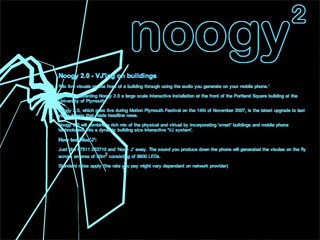
VJ’ing on buildings. (14/11/2007) Mix live visuals on the front of a building through using the audio you generate on your mobile phone. i-DAT presents: Noogy 2.0 a large scale interactive installation at the front of the Portland Square building at the University of Plymouth.

Noogy 2.0, which goes live during Motion Plymouth Festival on the 14th of November 2007, is the latest upgrade to last years Noogy that made headline news.

Noogy 2.0 will combine a rich mix of the physical and virtual by incorporating ‘smart’ buildings and mobile phone technologies into a dynamic building size interactive VJ system.


Noogy 2.0

Noogy 2.0

noogy2.jpg
– VJ’ing on buildings. (14/11/2007) Mix live visuals on the front of a building through using the audio you generate on your mobile phone. i-DAT is presenting Noogy 2.0 a large scale interactive installation at the front of the Portland Square building at the University of Plymouth. Noogy 2.0, which goes live during Motion Plymouth Festival on the 14th of November 2007, is the latest upgrade to last years Noogy that made headline news. Noogy 2.0 will combine a rich mix of the physical and virtual by incorporating ‘smart’ buildings and mobile phone technologies into a dynamic building size interactive VJ system. How too ‘Noo – J’: Just dial 07511 253710 and Noo – J away. The sound you produce down the phone will generate the visuals on the fly across an area of 50m2 consisting of 9600 LEDs. Standard rates apply (the rate you pay might vary dependent on network provider)http://www.noogy.org/ (rather poor phone movie..) http://www.youtube.com/watch?v=dqWS9m0osh0

Media Innovations Awards.

Media Innovations Awards.

mia.jpg
i-DAT is pleased to announce that¦ it won two awards at the recent Media Innovation Awards organised by Plymouth Media Partnerships: Multi-platform project Sponsored by Automatic TV and Media Multi-Platform Project Category winner: ‘Cornwall Culture’ i-DAT in association with Ollie Lindsey , Dan Efergan , Gendall Design and Chris Saunders for Cornwall Arts Marketing. For a great example of using a range of technologies to their fullest potential. Sponsored by ITV Westcountry Mobile Communications Category Winner: Noogy by Chris Saunders and Jamie Taylor in association with i-DAT and Lee Nutbean For the innovative way in which it used artificial intelligence to receive text information and respond to it. http://www.mediainnovationawards.com/

Noogy

Noogy

Noogy: 16 – 19 November 2006.

Portland Square, University of Plymouth. To talk to Noogy text: ‘noogy; and your question..’ to 07766404142. Noogy in residence is part of the Motion Plymouth Festival 2006. Noogy’s background is a little unclear. Some claim that Noogy arrived from deep space, originating somewhere off the shoulder of Orion, watching C-beams glitter in the dark near the Tannhauser gate. Others claim that Noogy grew from within the network of CAT6 Ethernet cables, silicon chips and data mines that form the core of the Arch-OS system in Portland Square. Whilst others still claim that Noogy was there all the time, waiting in the void for the digital interface that would allow his manifestation. Some say Noogy is the ‘building’, others that Noogy is just a ‘viral infection’, like a bad cold that cant be shaken.


Noogy took his personality from the Arch-OS system, he would get lonely when the CCTV cameras could not see anyone, cold and hit depending on the environmental sensors and responded to SMS interactions through a unique Artificial Intelligence system developed by Chris Saunders.

Noogy 2:

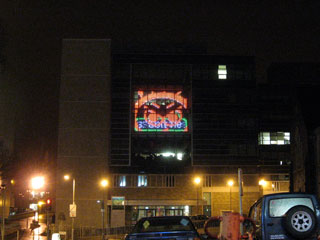
VJ’ing on buildings. (14/11/2007) Mix live visuals on the front of a building through using the audio you generate on your mobile phone. i-DAT is presenting Noogy 2.0 a large scale interactive installation at the front of the Portland Square building at the University of Plymouth. Noogy 2.0, which goes live during Motion Plymouth Festival on the 14th of November 2007, is the latest upgrade to last years Noogy that made headline news. Noogy 2.0 will combine a rich mix of the physical and virtual by incorporating ‘smart’ buildings and mobile phone technologies into a dynamic building size interactive VJ system. How too ‘Noo – J’: Just dial 07511 253710 and Noo – J away. The sound you produce down the phone will generate the visuals on the fly across an area of 50m2 consisting of 9600 LEDs.


And the invention of Noogy Filth when someone left the Lexicon of Filth switched off during testing.

Backend:


DMX lighting rig (5x8m) (many thanks to Pyramid), Flash, AI, SMS gateway, Arch-OS server…

Noogy in residence – part of the Motion Plymouth Festival 2006

Noogy in residence – part of the Motion Plymouth Festival 2006

noogy.jpg
(17/11/2006). Noogy: 16 – 19 November 2006. Portland Square, University of Plymouth. To talk to Noogy text: noogy; and your question.. to 07766404142. Noogy in residence is part of the Motion Plymouth Festival 2006. Noogy’s background is a little unclear. Some claim that Noogy arrived from deep space, originating somewhere off the shoulder of Orion, watching C-beams glitter in the dark near the Tannhauser gate. Others claim that Noogy grew from within the network of CAT6 Ethernet cables, silicon chips and data mines that form the core of the Arch-OS system in Portland Square. Whilst others still claim that Noogy was there all the time, waiting in the void for the digital interface that would allow his manifestation. Some say Noogy is the ‘building’, others that Noogy is just a viral infection, like a bad cold that cant be shaken.